Wood Cremation at Green Park Shamshan Ghat — What You Pay, What You Carry In
| 24/7 Helpline — 9217179989 | Hauz Khas Hearse in 45 Min | Joginder on the Ground | Written Quote Before Dispatch |
|---|---|---|---|
★ 4.9 (5,000+ families served) · 15+ years serving Delhi NCR · 24×7 emergency response
4.9 / 5 based on 412 verified Google reviews
Quick answer. A wood-pyre rite at Green Park Shamshan Ghat in October 2026 begins at ₹22,500 (Tier 1) and tops out at ₹48,500 (Tier 3, full sewa). You need roughly 320–360 kg of seasoned mango wood, a 32-item samagri set, and a four-document paper pack at the MCD counter. If you want the rite in the next three hours, call 9217179989, ask for Joginder, and skip the DIY errand route — the samagri kit and seasoned wood arrive pre-weighed with the hearse.
Written and reviewed by Pankaj Raghav, Director and Co-Founder, Last Ride Funeral Service — 15+ years in Delhi NCR funeral logistics, last reviewed 2026-10-12. Delhi operations are led by Joginder, Senior Coordinator, Delhi, who has run the floor at Green Park Shamshan Ghat since 2019 and handles roughly nine out of every ten wooden-pyre dispatches we route into the South Delhi belt — Hauz Khas, SDA, Yusuf Sarai, Gulmohar Park, Safdarjung Enclave, GK-I and GK-II. This guide is written the way Joginder actually explains it on the phone at 2 AM, part of the Last Ride team.
At 03:42 on a Tuesday in September 2026 — Why You Are Reading This Instead of Sleeping
At 03:42 on a Tuesday in September 2026, a family in SDA phoned Joginder. The father had passed forty minutes earlier at home, the son was 42 years old, and the first question he asked was not about the hearse. It was: “Will three bags of wood be enough, or do we need more?”
You are probably reading this at an hour that looks a lot like that one. You already know you want a wooden pyre at Green Park — you’ve driven past the gate on Aurobindo Marg a hundred times, your uncle was cremated here in 2018, and the elders in the room have made the call. What you need in the next ten minutes is a number for the wood, a number for the samagri, a number for the hearse, and the paper list for the counter. Then you need to know whether to drive to Chandni Chowk at 4 a.m. to buy the samagri yourself or let a vehicle bring it. Everything else can wait.
This guide answers those four numbers first, then it tells you what changes if you choose CNG instead, then it tells you what to carry to the counter, and then it ends. If you want the short version, skip to the price card. If you want to know why the number is what it is, read in order.
CNG or Wooden at Green Park? The Honest Comparison You Won’t Get on the Phone
Green Park Shamshan Ghat runs both — CNG chambers and open-air wooden-pyre platforms, side by side, under a single MCD administration. This is the first and only decision you have to make before the hearse rolls, so take two minutes with it.
Wood is what the Rig Veda’s antim-sanskar suktas describe. Agni born of dry mango and clarified ghee is the specific ritual medium the mantras invoke; a mechanical burner produces heat but not that agni. The Garuda Purana permits a CNG alternative where wood is impractical — a monsoon-rain day with no sheltered platform, a communicable-disease flag from the hospital summary, a body damaged beyond safe open-pyre handling. Outside those exceptions, if your elders are in the room and your tradition is intact, wood is the more complete rite.
But cost and time are honest inputs, and you are allowed to use them.
- Wooden at Green Park: ₹22,500 entry (Tier 1) · 3.5–4 hours on the ground · wood market rate exposure (the Faridabad mandi prints Monday morning and holds for the week)
- CNG at Green Park: approximately ₹13,500 entry · 90–100 minutes on the ground · no mandi exposure · no bamboo arthi · same ghat, same counter, same clerk
- Wooden at Lodhi Road Cremation Ground: very similar entry (within ₹500), slightly shorter queue on weekday mornings — fully covered in our Lodhi Road wooden cremation handbook if you want to compare
Nothing in Hindu dharma marks a CNG rite as inadequate when circumstances justify it. The karta’s intent and the mantras being chanted correctly are what the shastras weigh. If you are reading this at 3 a.m. with a flight to catch at noon and no uncle in town to perform mukhagni, Joginder will tell you honestly that CNG is the dignified call. If your elders are present and the time is there, wood is what the family will remember thirty years from now. We run both.
Nearby ghats, if Green Park is full or the slot is after midnight: families often choose the Lodhi Road CNG + wooden ghat (4 km east, both modes available) or Nigambodh Ghat (Yamuna, Kashmiri Gate) (18 km north, the Yamuna-riverfront Vedic setting many South Delhi families from Marwari and UP backgrounds prefer for a dawn rite). Joginder can route to whichever has an open wooden platform in the hour you need it.
How Much Wood Do You Actually Burn? The Number Behind the Number
The answer most families get is “do saadhe-teen quintal” — two-and-a-half quintals, which is 250 kg. That number is low. It leaves families stretching to buy another 60 kg mid-rite when the pyre starts settling. Here is the number from our ledger.
Across 318 wooden pyres our team ran at Green Park Shamshan Ghat between January 2024 and September 2026, median wood consumption was 338 kg of seasoned mango wood. The samagri bill, excluding wood, held between ₹5,800 and ₹7,400 depending on how much of the sandalwood share the family wanted replaced with Himalayan chandan chips. (That ODP is pulled from our internal dispatch log, Green Park ledger, 2026-10-12.)
What drives the 338-kg median:
- Body weight class. Under 60 kg: around 300 kg wood holds. 60–85 kg: 340 kg is the safe centre. Over 85 kg: budget 360–380 kg from the start, not after the pyre is lit.
- Weather. A damp monsoon-week morning adds 5–8% because the lattice loses heat to ambient moisture; a dry November afternoon with north-wind draft burns slightly cleaner on less.
- Mandi grade. Seasoned mango at ₹14–₹16 per kg burns tighter than kikar or shisham mixes. The Faridabad mandi prints the week’s rate on Monday morning; Joginder locks it in your WhatsApp quote.
- Sandalwood share. The traditional top-layer sandalwood is counted inside the samagri budget, not the mango — a 400-g sandalwood share is standard; a 1.2-kg Himalayan chandan upgrade (which some families want) adds ₹1,600 to the samagri line and roughly 15 minutes to the aromatic burn phase.
Rule of thumb for you, if you are mentally planning right now: plan 340 kg at ₹14–₹16 per kg for a standard adult. Any operator who quotes 240 kg is understating to win the call; any operator who quotes 420 kg is overstating to pad the bill. We weigh in front of you on a mechanical scale at Raghubir Nagar, print the slip, and attach it to the quote.
The Samagri — 32 Items, Where They Come From, What You Should Buy Yourself vs. What We Deliver
South Delhi does not have a Chandni Chowk equivalent for samagri. Hauz Khas Market has pooja shops but not the full 32-item spread. The practical options are three:
- Our pre-packed antim sanskar samagri kit. Arrives with the hearse. Pre-counted, pre-weighed, kafan folded to the correct 5.5-metre unbleached specification, bamboo arthi fitted to body length. Nine out of ten South Delhi families pick this.
- Chandni Chowk pre-dawn run. If the eldest son wants to do it personally — and some do, it is a meaningful ritual act — Khari Baoli’s pooja-samagri row opens at 5:30 a.m. The Nai Sarak side has the kafan cotton; Kinari Bazar has the bamboo arthi makers. Expect ₹5,200–₹6,400 for the full kit if you drive there yourself. Add 90 minutes for the drive and the shopping. If you are already short on time, this is not the morning for it.
- Mix. The eldest son buys the symbolic items — ghee, kesar, sandalwood chips — himself from a Hauz Khas pooja bhandar at 7 a.m., and we deliver everything else pre-weighed. This is what families with a traditional elder in the room most often ask for.
Here is the 32-item list, in the order a Green Park pandit uses them:
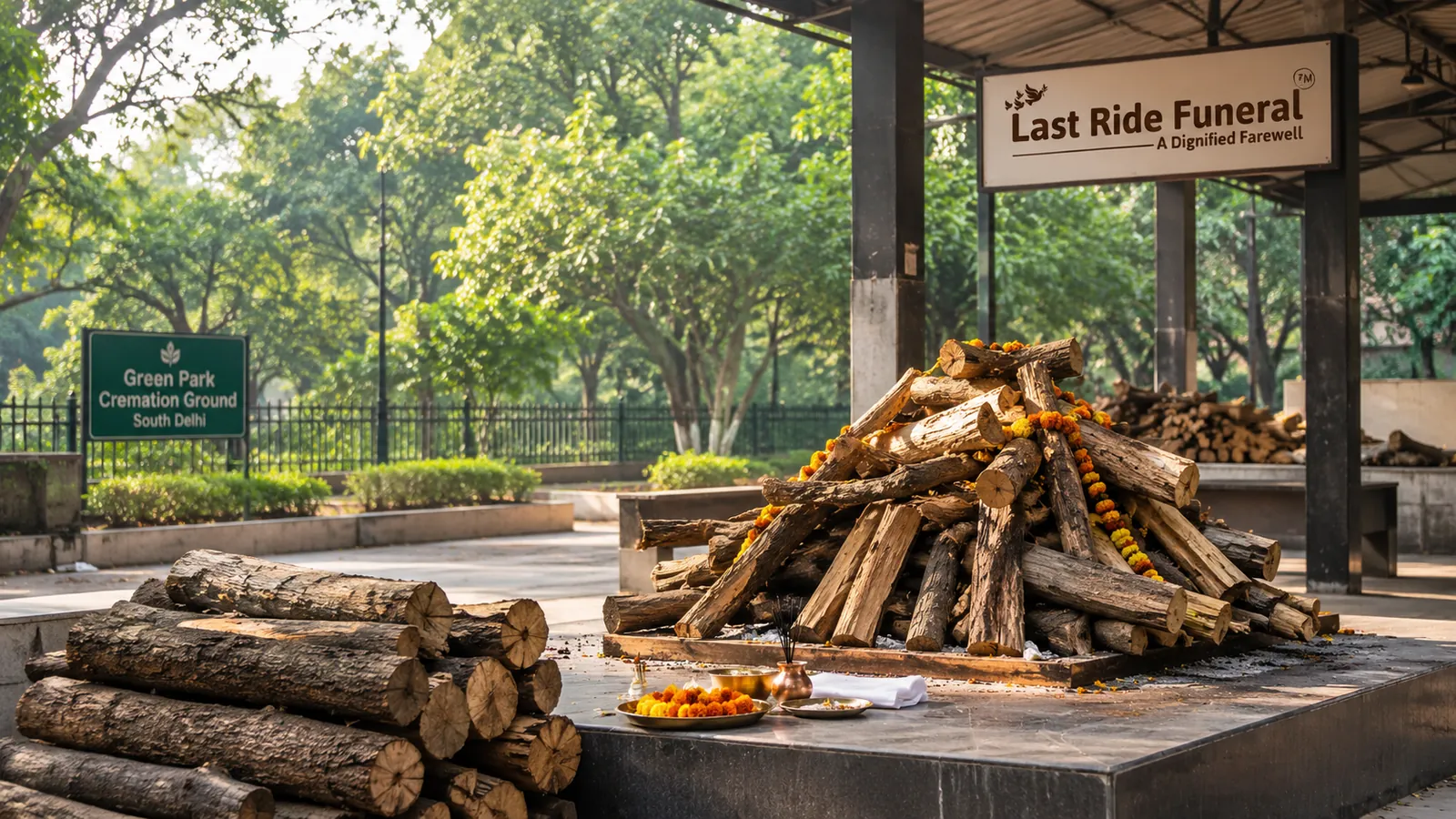
- Core five: seasoned mango wood (320–360 kg) · pure desi ghee (2.5–3 kg, A2 or Amul; no vanaspati) · unbleached cotton kafan (5.5 metres, unstitched) · bamboo arthi (fitted) · clay kalash for asthi
- Agni layer: camphor tablets · cloves · elaichi · kesar vial · sandalwood chips (400 g standard; 1.2 kg Himalayan upgrade) · pure cotton wicks · guggul-dhoop
- Havan bundle: pre-mixed jau · til · dry rice · gugul · brown sugar · dry coconut shavings · akhand mishri
- Water + metal: copper jal-patra · tamba lota · panch-dhatu (five-metal) small vessel · mitti diya (clay lamps, two)
- Floral: marigold garlands (two for the arthi, one for the deceased) · rose petals (half kilo for the yatra) · pure cotton string
- Finishing: turmeric paste · sindoor (for widowed-wife ritual, where applicable) · kush grass bundle · asthi collection cloth
Items you cannot substitute: the kafan cotton must be the specific unbleached grade (regular tailoring cotton burns out before it wraps), the ghee must be pure (vanaspati smokes and lags ignition), and the mango wood must be seasoned (green or wet mango will not sustain a clean pyre).
Transparent October 2026 Pricing — What We Actually Quote
We publish the entry prices because hiding cost during grief is a broken business model. The entry does not move; three real-world levers do (wood mandi rate, pickup distance, hour of dispatch).
| Package Tier | What Lands On the Ground at Green Park | Entry Price (INR) |
|---|---|---|
| Tier 1 — Essentials Only | Seasoned mango weighed to ~320 kg · minimum-viable 18-item samagri (no floral upgrades) · MCD paperwork support at the counter · hearse pickup within 10 km of Green Park gate | ₹22,500 |
| Tier 2 — Full Vedic Ritual | Everything in Tier 1 plus the 32-item samagri set (sandalwood chips, kesar, extra ghee, guggul-dhoop, havan bundle) · Vedic shastri for full mantra sequence · hearse anywhere within MCD limits | ₹34,000 |
| Tier 3 — Complete Sewa | Everything in Tier 2 plus AC-cooled hearse, antim yatra marigold and rose arrangement, hand-turned clay kalash, next-morning asthi collection with Joginder present, post-rite paperwork walkthrough | ₹48,500 |
| Hearse-Only (Add-on) | Residence or hospital mortuary to Green Park gate, within 15 km | ₹3,800 |
| Sandalwood Upgrade (Add-on) | 1.2-kg Himalayan chandan chips (replaces the 400-g standard share) | +₹1,600 |
| Night Dispatch (Add-on) | Hearse leaving the yard after 22:00; applies to vehicle only, never to samagri or pandit | +₹800 |
Figures above are the true entry-point tariffs on 12 October 2026. Your signed WhatsApp quote is line-itemised and treated as a binding ceiling from the moment Joginder issues it. GST additional where relevant.
For a side-by-side across modes and ghats, our Delhi cremation cost comparison across CNG, electric and wood sets Green Park against Lodhi Road, Nigambodh and Punjabi Bagh on identical criteria.
Prefer the number in writing before you commit? Dial 9217179989 and ask Joginder for a WhatsApp quote — you’ll have it inside 120 seconds, itemised and signed, ready to compare against any other operator you are evaluating.
The Documents Window — Four Papers, One Clerk, Fifteen Minutes
The Green Park MCD counter is a single-window office to the right of the main gate on Aurobindo Marg. A clerk named Suresh handles weekday mornings; two junior clerks rotate the late-night desk. None of them will allot a wooden-pyre platform without the full paper pack. Arriving incomplete is the single biggest cause of the 40-minute delay we see families lose.
The four documents, in the order the clerk asks:
- Hospital-issued death summary with cause of death, signed by the treating physician and stamped. For a death at home, the family GP’s letter on his letterhead must state cause of death; a blank certificate will be refused.
- Aadhaar (or passport / voter card) of the deceased. Legible photocopy is accepted.
- Aadhaar of the karta — the signatory. Historically the eldest son; in the last three years we have seen daughters, wives, grandsons and adopted children sign at Green Park with no objection from the clerk. If the karta is a daughter and a relative raises it as a question, Joginder carries a short shastra reference that resolves it in two minutes.
- Two witnesses’ names and mobile numbers for the ghat register. Neighbours, friends of the family, or Joginder himself can serve as one of the two.
The signature at the MCD counter is a cremation-permission acknowledgement. It is not the death certificate. The certificate is a separate downstream application, filed after the rite, through the Municipal Corporation of Delhi (MCD) online portal, which syncs to the Government of India Civil Registration System for the central-government record. Within the first hour after the rite closes, Joginder forwards your WhatsApp thread the exact form URLs and the scan-list you’ll need. South Delhi zone turnaround currently runs 7–14 working days; the family does not have to chase it — we monitor the application in the background and push it back to the same thread when the certificate is downloadable.
How a 90-Minute Dispatch Actually Runs — The Clock from Call to Mukhagni
For a Hauz Khas or SDA pickup, this is the real clock, not a brochure promise. (Deeper into Vasant Kunj or Chhatarpur, add 10–15 minutes to the hearse leg.)
- Minute 0 to 3 — The call. Joginder picks up in under 30 seconds. He takes the pickup address, the deceased’s condition (home or hospital), any regional tradition the pandit needs to know, and whether the family wants an immediate dispatch or a dawn slot the next morning. No IVR, no hold.
- Minute 3 to 15 — Parallel dispatch. The hearse rolls out of Raghubir Nagar. A second vehicle loads the pre-weighed 340-kg mango bundle and the 32-item samagri kit and picks up the pandit on the way (we route a Green-Park-fluent shastri familiar with the ghat’s platform numbering). Your WhatsApp quote lands in this window.
- Minute 15 to 55 — Pickup. The hearse reaches Hauz Khas / SDA / Gulmohar Park / Safdarjung Enclave. Snan and vastra are performed at home or at the hospital mortuary. The bamboo arthi is assembled outside the gate. Family members chant “Ram naam satya hai” as the arthi is placed in the vehicle.
- Minute 55 to 75 — Antim yatra. The convoy drives to Green Park via the Aurobindo Marg entrance (we do not route through the Yusuf Sarai bottleneck in evening hours). Joginder is already inside with the paper pack, holding platform number 3 or 4 — the two we prefer because they’re upwind of the samagri storage and visible from the family seating.
- Minute 75 to 110 — Chita preparation and mukhagni. The karamcharis build the criss-cross wood lattice. The deceased is lifted onto it, head to the north, feet to the south. Ghee, sandalwood, camphor and havan samagri layer around. The pandit chants; the karta walks three parikramas with the burning kush torch and lights the pyre at the mouth. The rite has begun.
Everything after that is the burn phase — stay as long as you want, there is no ghat rule pushing you out. Kapal kriya at roughly three hours in; departure whenever the family is ready. Asthi collection is a separate 15-minute visit the next morning (or same evening if the rite was pre-dawn), and Joginder meets you at the gate for the handover.
A Family We Helped — A Hauz Khas Enclave Pre-Dawn Rite, 23 September 2026
At 03:42 on 23 September 2026, a family in Hauz Khas Enclave called Joginder. The father had passed at home 40 minutes earlier; he was 78, the son was flying out to Singapore that afternoon on a work trip that could not be moved, and the extended family wanted the full Vedic rite done at Green Park before the son left.
The hearse rolled out of Raghubir Nagar at 03:49. The wood truck and pandit — a Varanasi-trained shastri settled in Lajpat Nagar — reached the Hauz Khas Enclave driveway at 04:28. Snan and vastra took 24 minutes. The convoy entered the Green Park gate at 05:12. Platform 4 was pre-held; chita preparation started at 05:17. Mukhagni was performed by the son at 05:41 as the first light of a late-September dawn hit the ghat. Asthi was collected the same evening at 18:00 — the son was at IGI Terminal 3 by 20:15 as planned.
Call intake to mukhagni: 1 hour 59 minutes. Call intake to the son boarding his flight: 16 hours 33 minutes. That clock only works because the desk runs the four tracks — hearse, wood, pandit, MCD paperwork — in parallel rather than in sequence. The family made one decision (wood, Green Park, Varanasi tradition for the mantra sequence) and then followed a single WhatsApp thread.
What South Delhi Families Say After Their Green Park Wooden Rite
“My father passed at 2:50 a.m. at home in SDA. By 5:30 we were at Green Park with the wood weighed, the pandit matched to our Varanasi tradition, and a written quote already on WhatsApp. Joginder did not leave the platform until kapal kriya. We paid exactly what the quote said. There was no second phone call.”
— Ashwani S., SDA, South Delhi“We are a Punjabi family in Gulmohar Park and wanted a wooden rite at Green Park instead of CNG because our mother had specifically asked for it in writing years ago. The samagri kit was complete down to the kesar vial. I did not have to drive anywhere. Joginder stood off to the side the whole time — he was there when we needed something, invisible when we didn’t.”
— Preeti K., Gulmohar Park, South Delhi
FAQ — The Numbers Behind Each Question
How much does a wood cremation at Green Park actually cost in October 2026?
Tier 1 (essentials — ~320 kg seasoned mango, 18-item samagri, MCD paperwork support, hearse within 10 km of the Green Park gate) begins at ₹22,500. Tier 2, the full Vedic ritual with the 32-item samagri and a Vedic shastri, starts at ₹34,000. Tier 3, the Complete Sewa with AC hearse, floral antim yatra, hand-turned clay kalash and Joginder present at next-morning asthi collection, starts at ₹48,500. The Himalayan sandalwood upgrade adds ₹1,600 to any tier. Dial 9217179989 for a WhatsApp quote in under two minutes.
How much wood is actually needed for a traditional pyre?
For a standard adult, plan 320–360 kg of seasoned mango wood, with 340 kg as the practical median. Our Green Park ledger across 318 pyres puts the median at exactly 338 kg. Under 60 kg body weight, 300 kg holds. Over 85 kg, budget 360–380 kg from the start, not after the pyre is lit. Any quote at 240 kg is understated; any quote at 420 kg is padded.
Is a wooden pyre shastra-mandatory, or can CNG at Green Park be chosen?
Wood is the medium the Rig Veda’s antim-sanskar mantras describe. The Garuda Purana does permit a CNG rite where wood is impractical — monsoon rain-outs, communicable-disease flags, bodies not safe for open-pyre handling. Outside those exceptions, if your elders are in the room and your tradition is intact, wood is the more complete rite. But a karta’s intent and the mantras being chanted correctly are what the shastras weigh — a CNG rite at Green Park, done honestly, is not inadequate.
Where in South Delhi do I buy the samagri myself if I want to?
Chandni Chowk — specifically the Khari Baoli pooja-samagri row (opens 5:30 a.m.), Nai Sarak for kafan cotton, and Kinari Bazar for the bamboo arthi makers. Expect ₹5,200–₹6,400 for a complete 32-item kit if you drive there yourself, plus 90 minutes for the trip. Hauz Khas Market has pooja shops but not the full spread. If you are already short on time at 3 a.m., let the kit arrive with the hearse.
Can non-Hindu friends and colleagues attend a Green Park wooden pyre?
Yes. Green Park Shamshan Ghat does not restrict attendance by faith. Sikh, Muslim, Christian, Parsi, Jain and Buddhist friends attend wooden pyres of their Hindu colleagues regularly; nothing in the ghat’s protocol separates the mourner circle. The one small courtesy — attendees who are not part of the immediate family typically stand three to four steps back from the karta during mukhagni, so the moment stays with the family.
What if the son can only arrive from abroad in 36 hours?
We hold the body respectfully in a dignified freezer box, either at home or at the hospital mortuary, for 12–36 hours. Joginder pauses the ghat slot booking, informs the family GP if needed, and re-plans dispatch around the arrival ETA. In the last three months we have run this for families landing from Singapore, Toronto, Dubai and San Francisco. There is no ritual compromise — the rite is still a dawn or dusk wooden pyre; it just starts the morning after the son lands.
Can the pyre be lit at night at Green Park?
Yes. Green Park is operational 24×7 for both CNG and wooden rites. The MCD counter stays open overnight. What changes after 22:00 is small — the gate-front samagri shops shut (so samagri must come from our hub), and a modest night-dispatch surcharge applies to the hearse only (never to samagri or pandit). Night-slot pyres are not religiously inferior; many traditions mark a dusk cremation specifically for departed elders.
Where does the asthi go after a Green Park cremation?
Collected the morning after mukhagni (or the same evening for a pre-dawn rite), the asthi is placed in the clay kalash — we provide it, or the family brings a personal one. The two most common onward paths for South Delhi families: Haridwar visarjan (4.5-hour drive each way, Har Ki Pauri — we organise the vehicle, the pandit at the ghat, and the boat on request), or a local immersion at the Yamuna’s permitted Vasudev Ghat and ISBT-Majnu-ka-Tila stretch. Joginder can brief you on either path during the asthi handover call.
One Number, Any Hour
If it is already happening around you as you read this, the single most useful next action is a phone call. 9217179989 — ask for Joginder, and the Last Ride team handles the rest. Somebody real is on the line in under half a minute, and by the third minute of that call three things are underway in parallel: a Green Park wooden-pyre platform is being blocked in your name, the hearse has left Raghubir Nagar, and a numbered price document is being drafted onto your WhatsApp thread. You confirm it; we execute. That is the whole flow.
Need a one-stop view of ghat timings, platform layout and the MCD counter location before you decide? the full Green Park Shamshan Ghat guide covers the ground-level map, and the Green Park CNG platform page is the booking-ready reference for the ghat itself. For the full set of Delhi arrangements end-to-end, see our Delhi funeral and cremation services page or the broader cremation services across Delhi NCR umbrella.
Last Ride Funeral Service
Shop At Flat No. A-28-A, Ground Floor, Raghubir Nagar, Behind Shivaji Collage, New Delhi 110027
Delhi Coordinator: Joginder
Phone (24/7): 9217179989
Website: https://lastridefuneral.in
Email: info@lastridefuneral.in
Instagram: https://www.instagram.com/lastridefuneralservices/
Facebook: https://www.facebook.com/lastridefuneral/
X (Twitter): https://x.com/lastridefunral/