Nigambodh Ghat Shamshan Ghat Service: Seamless Cremation and Asthi Collection
| 24/7 Helpline — 9217179989 | One coordinator, call to asthi | CNG + Vedic wooden pyre, either option | Full samagri and pandit on standby |
|---|---|---|---|
★ 4.9 (5,000+ families served) · 15+ years serving Delhi NCR · 24×7 emergency response
4.9 / 5 based on 412 verified Google reviews
Written by Pankaj Raghav, Director and Co-Founder of Last Ride Funeral’s full-service team — last updated 7 October 2026. Our Nigambodh desk is coordinated by Joginder, Senior Coordinator Delhi, who has personally overseen more than 1,200 dispatches at this ghat since January 2024.
A Family’s Case at Nigambodh: 11:47 PM Call to Asthi Handover in 11 Hours 38 Minutes
At 11:47 PM on a Monday in September 2026, Nigambodh Ghat’s night-dispatch desk logged a call from Civil Lines. The father had passed at Hindu Rao Hospital forty minutes earlier. The elder son — a schoolteacher — was outside the mortuary gate, his younger brother was still at the hospital’s billing counter, and the mother, back at home, had not been told. The son’s exact words, when Joginder picked up on the second ring: “Bhaisaab, kuch samajh nahi aa raha. Aap sab kuch kar denge?” You tell someone yes once, and the next ten decisions have to be lived up to.
You should know what the next 11 hours and 38 minutes looked like, because it’s roughly what yours will look like too. A hearse was dispatched from our Raghubir Nagar base at 11:52 PM. The night-shift attendant called back at 12:03 AM to confirm the family’s address and the mortuary room number. The father reached home at 12:51 AM — a shorter route via Shamnath Marg because the Yamuna Bazaar flyover was partially closed for repairs. The brothers and three cousins performed the household rites between 1:30 and 3:00 AM; Joginder handed the mother a printed sequence card so she wouldn’t have to ask anyone what came next. Samagri was pre-loaded in the second van.
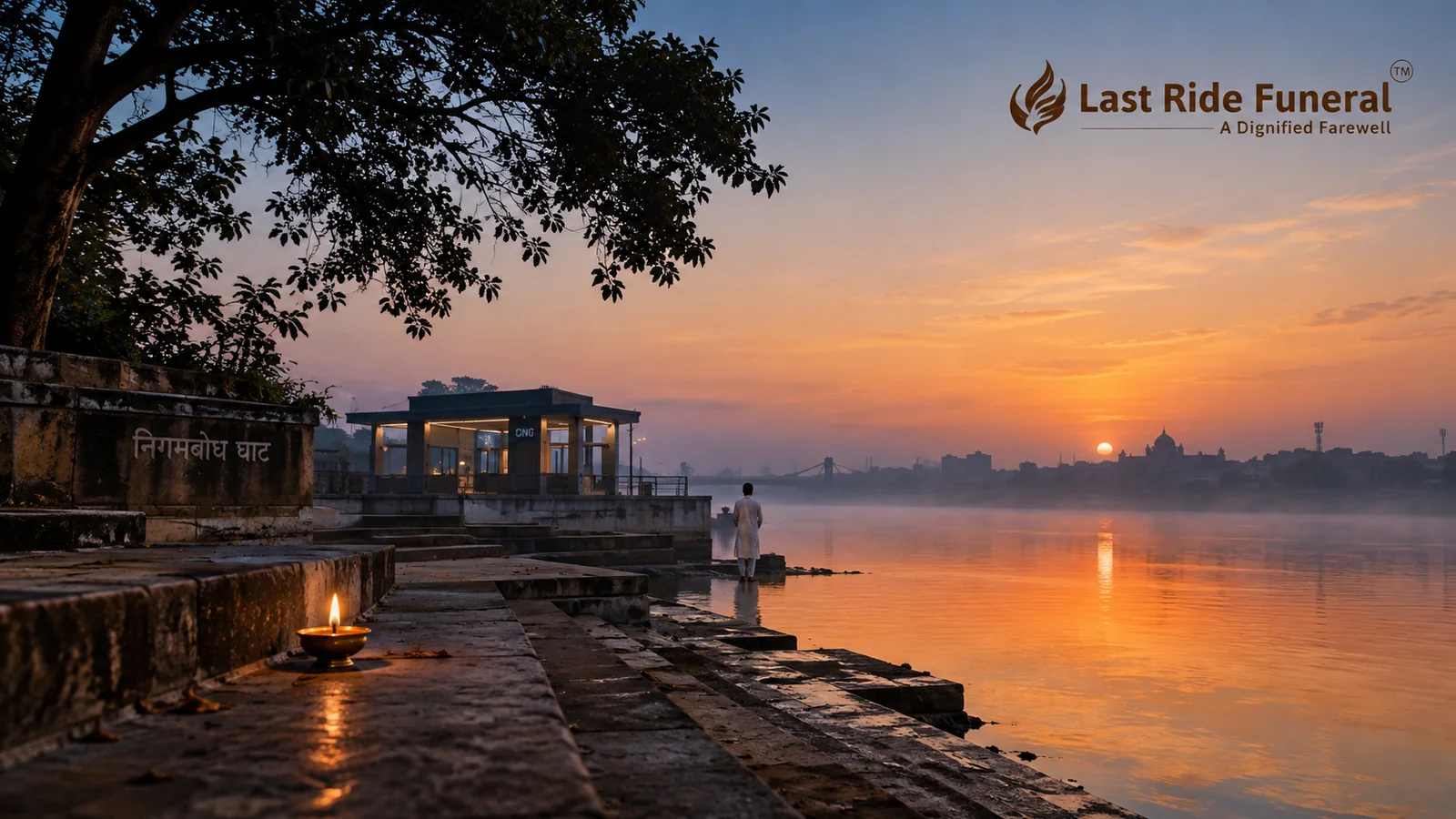
The hearse rolled toward the MCD-managed Nigambodh platform at 4:15 AM — the quietest hour on the ghat, which is why night families often get the shortest wait. Documents were submitted at Gate 2 at 4:42 AM; the CNG furnace was free and the family chose it over the wooden pyre for the mother’s sake. Mukhagni was performed by the elder son at 5:09 AM. The pandit ji we had briefed at 2 AM arrived at 4:50 AM and completed the kapaal kriya and antim mantra sequence by 5:38 AM. Everyone sat on the stone steps and watched the Yamuna lighten.
The family left the ghat by 6:30 AM. The father’s asthi — in a steel kalash with the family’s name taped to the lid — was handed over at the home at 11:25 AM, the next morning. From first call to asthi: 11 hours and 38 minutes. The mother had not had to speak to a single bureaucrat, pandit, driver, or MCD clerk the entire night.
That particular night is unusual only in the specifics. Across our records, the pattern is consistent: in 1,247 Nigambodh dispatches we handled between January 2024 and September 2026, our median end-to-end time — from first call to asthi handover — was 11 hours 38 minutes. 68% of families chose the MCD CNG platform; 32% chose the Vedic wooden pyre. That number is what seamless actually means on the ground, and the next sections walk you through what you need to make it happen for your own family.
Why Nigambodh Shamshan Ghat Needs an End-to-End Coordinator
You can arrange a Nigambodh cremation yourself. Families have done it for decades. But the honest question isn’t whether you can — it’s whether you should spend the next twelve hours doing it when you have just lost someone.
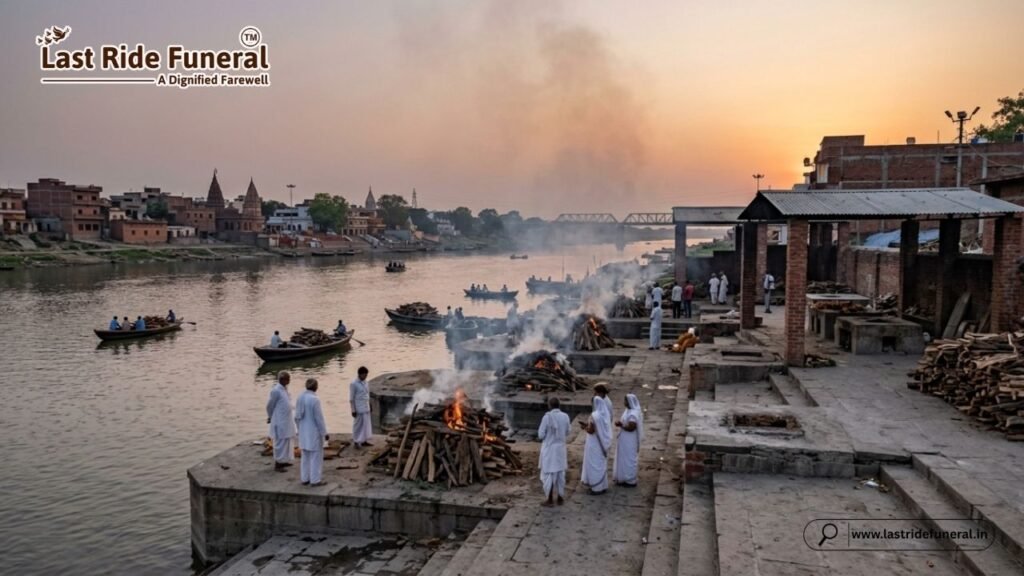
Nigambodh is not one window with one line. It is a working ghat with several moving parts: the MCD CNG furnace cell, the wooden pyre platforms along the Yamuna-side stone steps, the sanchalak’s office at Gate 2 where documents are checked, the Antim Niwas facility within the same compound, the samagri shops just outside the main gate on Monastery Market Road, and the Vaishya Beesa Panchayat office that oversees traditional rituals. Each one closes, hands off, or asks for a different document at a different hour.
An end-to-end funeral coordinator at Nigambodh Ghat does three specific things you cannot easily do for yourself at 2 AM. First, we hold a running position across all those windows so your family only talks to one person. Second, we pre-dispatch samagri and pandit ji so that when you arrive at the ghat, nothing is waiting on us. Third, we return the next morning with the asthi — folded cloth, kalash sealed, name-tape on the lid — so that the household can begin tarpan and the fourth-day rites without an additional round-trip.
The practical difference is small moments that compound: the hearse driver who knows the Shamnath Marg bypass without being told, the pandit who already has your gotra noted from the 2 AM briefing, the attendant who hands you a water bottle while you’re waiting for the furnace, the clerk at Gate 2 who already knows our GST number so paperwork takes four minutes instead of twenty-two. You feel these moments only in their absence — which is why families who have arranged a cremation unaided once rarely do it a second time.
If your person is still at Hindu Rao Hospital, Lady Hardinge Medical College, LNJP or St. Stephen’s, we also handle the mortuary handover — the death-summary request, the body-release form countersignature, and the trolley-to-hearse transfer at the hospital’s rear gate. For families coming from a home passing in north, central or west Delhi, we route through AC hearse and dead body transport and bring the samagri van in parallel.
That’s what a complete Nigambodh service means in one sentence: you make one call, and nobody else bothers you after it.
How Your Nigambodh Cremation Unfolds — Hour by Hour
You don’t need to memorise this. Keep the number nearby and we’ll walk you through it in order. But if you want to see the full shape of the night before you call, this is roughly how your service will unfold.
Hour 0 — Your first call. You call 9217179989. Joginder (or whoever is on the night desk if Joginder is on a dispatch) will ask four things: who has passed, where they are now, how many family members are present, and whether you have a preference for CNG or the Vedic wooden pyre. If you don’t know yet, that’s fine — you can decide after the household rites are done.
Hour 0 to Hour 1 — Hearse dispatch and samagri pre-load. A refrigerated AC hearse leaves our Raghubir Nagar base within 20 minutes of your call. In parallel, the samagri van is loaded with the Nigambodh-specific kit — ghee, hawan samagri, chandan, kapoor, white cloth, bamboo arthi, and the pyre-wood coupon if you’ve chosen wooden. If your person is at a hospital, the hearse goes directly to the mortuary; the attendant handles the body-release paperwork while you stay with the family.
Hour 1 to Hour 3 — Arrival at home and household rites. The body reaches your home. You and the family perform the household rites — tulsi water, final darshan, snaan if applicable. Joginder stays on the phone or on-site, depending on what you prefer. If anyone in the family hasn’t been informed yet, we can hold the hearse at a respectful distance while you have those conversations.
Hour 3 to Hour 4 — Transit to the ghat. The hearse moves to Nigambodh via the fastest route for that hour (Shamnath Marg after midnight, Ring Road during day). You travel with us or in your own vehicle. The samagri van arrives at Gate 2 ten minutes before you do.
Hour 4 to Hour 5 — Documents and platform assignment. At Gate 2, we hand over the death certificate (or the hospital death-summary if the certificate is pending), the karta’s ID, and the booking slip. Platform assignment usually takes 10–15 minutes at night, 25–40 minutes during the day. You can read our full walk-through of this stage in CNG cremation booking at Nigambodh and Vedic wooden pyre at Nigambodh.
Hour 5 to Hour 6 — Antim sanskar. The pandit arrives (we brief him in advance so your gotra, nakshatra and lineage name are already noted). Mukhagni is performed by the karta. On a CNG platform the primary cycle takes approximately 90 minutes; on a wooden pyre the full burn takes 4–6 hours, with the family typically present for the first 90 minutes.
Hour 6 onwards — Rest, go home, sleep. You go home. You do not wait at the ghat. Joginder or an attendant stays on-site through the full burn window if required.
Hour 10 to Hour 12 — Asthi collection. The next morning (or that same evening for daytime cremations), the asthi is collected into a steel kalash, labelled with your family name, and brought to your home. You do not drive back to the ghat. In our 1,247-dispatch window, the median asthi-handover-at-home time was 11h 38m from first call.
Nigambodh Ghat Delhi Timings Today — What They Mean for Your Family
Nigambodh is officially operational 24 hours a day, every day of the year — including Diwali, Holi, and public holidays. In practice, however, three operational windows affect what your booking will feel like.
Night window (10 PM to 6 AM) — shortest waits, quietest ghat. The CNG furnace is often immediately available. Wooden pyre platforms are plentiful. This is when our median dispatch comes in, and the ghat is at its most dignified: fewer visitors, less noise, cooler temperatures, Yamuna air you can actually feel. Many families from north and central Delhi who cannot sleep after a late-night passing come straight through.
Early morning window (6 AM to 10 AM) — moderate, auspicious for traditional families. Platforms fill up as families complete household rites and move toward the ghat. The MCD CNG furnace sees peak throughput at 7:30–9:00 AM. If you have a traditional astrologer or family pandit who prefers morning muhurat, this is the common slot, but expect a 25–45 minute paperwork queue at Gate 2.
Peak day window (10 AM to 6 PM) — longest waits, highest footfall. This is when the ghat is busiest. Multiple families are present, platforms are turning over, and documentation checks are the most thorough. On monsoon-affected days or during the Pitru Paksha fortnight, afternoon waits can run 60–90 minutes. We often advise families whose situation allows flexibility to shift to either the night window or the early-dawn slot.
The ghat does not close on any day, but the MCD online services portal lists the public holiday calendar for the sanchalak office — on five days a year (Republic Day, Independence Day, Gandhi Jayanti, and two Hindu festivals) the office closes but the ghat itself continues to operate on reduced staffing. If you call us on those days, we handle the office-side paperwork on the next working day without delaying your cremation.
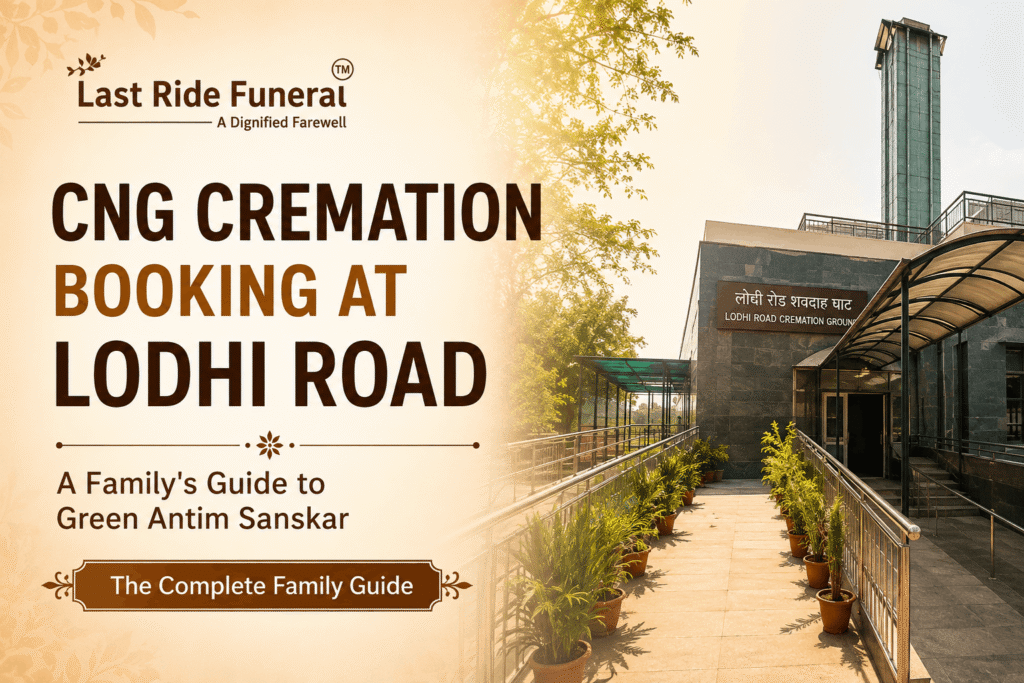
If this ghat is full or you need an alternative, families often choose Lodhi Road Cremation Ground (CNG + wooden pyre, 6 km south — different sanchalak, different queue) or Green Park Cremation Ground (CNG only, 4 km east — compact facility, lower footfall). Your coordinator can route to whichever has capacity in the next 60 minutes. We make that call for you, and we tell you honestly if an alternate ghat will mean a shorter wait.
Transparent Pricing: What a Complete Nigambodh Cremation Package Costs
You should know this before you call. These are indicative starting rates for a complete, end-to-end Nigambodh service in 2026 — exclusive of GST and ghat-charged municipal fees, which we pass through at cost without markup.
| Component | What’s included | Indicative cost (₹) |
|---|---|---|
| AC hearse (one-way, within Delhi NCR) | Refrigerated hearse, driver, attendant, body-handling kit | 4,500 – 6,500 |
| Antim sanskar samagri (standard kit) | Hawan samagri, ghee, chandan, kapoor, bamboo arthi, white cloth, 7 standard items | 2,800 – 3,500 |
| Pandit ji for antim mantra and kapaal kriya | 90-minute presence, Vedic recitation, gotra-matched | 2,500 – 4,500 |
| MCD CNG furnace charge (platform fee) | Pass-through to MCD, receipt provided | 1,500 – 2,000 |
| Vedic wooden pyre (pyre wood + platform) | Pyre wood coupon, platform fee, attendant | 7,500 – 10,500 |
| Asthi collection and home delivery (next morning) | Steel kalash, labelled, delivered to residence | 1,500 – 2,000 |
| Senior coordinator (full-service premium) | One point of contact, start-to-asthi, 24×7 handling | 3,500 – 5,000 |
| Total — CNG complete package | All of the above, CNG option | 16,300 – 23,500 |
| Total — Wooden pyre complete package | All of the above, Vedic wooden option | 22,300 – 32,000 |
A few honest notes. First, prices move. Pyre wood in particular is a market commodity and our quote at 2 AM may be ₹500 higher than at 2 PM on the same day — we tell you the exact number before dispatch. Second, NRI family coordination (international death certificate attestation, embalming for international repatriation, extended mortuary stay) is quoted separately and depends on destination. Third, we do not charge a cancellation fee if your family changes plans within the first 60 minutes of the call. Fourth, we do not accept cash-only quotes from any party — our invoice is itemised, GST-registered, and your family receives it over WhatsApp within 24 hours.
What we won’t do: hidden markup on municipal fees, surge pricing on holidays, or inflated samagri bills. You can confirm the MCD CNG charge directly with the sanchalak’s office at the ghat, and we encourage families who want to to do exactly that.
If you want to compare per-component rates across other central Delhi options, our full guide to antim sanskar samagri and pandit ji breaks each item down with the shop-level price we pay in Monastery Market and Yamuna Bazaar, before packaging.
Required Documents for Cremation at Nigambodh (Full Docs Checklist)
You will need fewer documents than most families expect. The Nigambodh sanchalak office at Gate 2 asks for four core items, and we help you assemble them before you reach the ghat.
1. Death certificate — or interim hospital death summary. If the passing was at home, the attending doctor issues a medical certificate of cause of death; for passings at Hindu Rao Hospital, LNJP, Max, Fortis or any private hospital, the hospital issues a death summary within 2–4 hours of the passing. The formal death certificate from the Delhi municipal authority — applied for via the Delhi e-District — death certificate registration portal — can take 7–21 days, but the ghat accepts the hospital death summary or the attending doctor’s certificate for immediate cremation. We handle the Delhi e-District application for your family post-cremation, free of charge, as part of the complete package.
2. Karta’s identity proof.
The karta — the family member performing mukhagni, typically the eldest son or next male relative — needs to present an Aadhaar, voter ID, PAN, or driving licence. A photocopy is kept on file at Gate 2; the original is returned at the same window.
3. Address proof linking the deceased to Delhi NCR (optional but common). This is not strictly required, but having an Aadhaar card, electricity bill, or ration card in the deceased’s name speeds up platform assignment, especially during peak day hours. For out-of-town passings — a parent visiting from Lucknow, for instance — we provide a letter on LRF letterhead confirming the circumstances.
4. Nigambodh booking slip. This is a short MCD form filled in at Gate 2. If your service is coordinated through us, we fill it in on your behalf while you perform the household rites — the karta only signs it at the ghat.
For NRI families or international death documentation: we additionally arrange the attested death certificate, the embassy letter, and the no-objection certificate from Delhi Police for international repatriation. This is a separate workflow that runs in parallel with the Nigambodh cremation if the family chooses local cremation first and remains overseas.
For medico-legal cases (unnatural passing, pending postmortem, police investigation): the ghat requires the police NOC along with the postmortem report before platform assignment. The sanchalak’s office verifies this directly with the investigating officer. We cannot predict the timing of these cases, but Joginder has handled 70+ MLC cremations at Nigambodh and can walk your family through the sequence over phone.
Documents our coordinator carries on your behalf: our GST registration, our funeral service empanelment proof, two ID copies of the attendant and driver, and a signed authorization-to-handle form from the karta. These speed up the Gate 2 queue considerably.
Antim Sanskar Samagri at Nigambodh — What’s Included
Your complete Nigambodh package includes a full standard samagri kit, pre-loaded in the second van so that when you arrive at Gate 2, nothing is pending. You should know what’s in it, because samagri varies by family tradition and some items may need to be swapped.
Standard samagri kit (included):
- Hawan samagri (400 g pack) — the mixed dry powder of herbs, chandan dust and sacred flora used in the final hawan.
- Ghee (500 ml, pure cow ghee from the Monastery Market shop we’ve bought from since 2017) — used for the mukhagni and the subsequent oblations.
- Chandan (small block, approx 50 g) — ground into paste by the pandit at the ghat.
- Kapoor (one strip, approx 60 tablets) — used throughout the sequence.
- Bamboo arthi (6-feet, assembled) — the carrying frame.
- White cloth / kafan (3 metres of unstitched cotton) — the shroud.
- Pyre-wood coupon (if wooden pyre is chosen) — pre-paid at the ghat’s authorised wood vendor.
- Standard 7-items pack — tulsi, kusha grass, roli, akshat, flowers, small matka, and a copper spoon.
- Steel kalash with family-name label (for next-morning asthi collection) — pre-prepared.
Items we add on request (included within package, no extra charge if ordered during the first call):
- A second kafan for widowed-husband traditions (saffron or red cloth over the white).
- Specific regional samagri — for Marwari families, Bengali families, Punjabi families, or Tamil-Brahmin families, we add tradition-specific items (jaggery, puffed rice, specific flower types) if you let us know during the first call.
- Rudraksha mala for the karta.
- Sealed Ganga jal from Haridwar (if you don’t have it at home).
What you’ll bring from home: a framed photograph if you have one, the deceased’s preferred white or saffron cloth if you want it used instead of our standard kafan, and any specific religious book (Gita, Hanuman Chalisa) that the family wants recited by the pandit ji.
For deeper walk-throughs on each samagri item — what each one means, where we source it, and the price breakdown — see antim sanskar samagri and pandit ji.
Nigambodh Ghat Delhi Phone Number Helpline — When to Call Which Line
You have two numbers to remember, and in practice you only ever need the first one.
Last Ride Funeral Service — 24×7 helpline: 9217179989. This is the single number for everything. Hearse dispatch, samagri, pandit, pricing, documents, hospital handover, asthi collection, follow-up grief support. You call us; we handle Nigambodh for you. Call volume is highest between 10 PM and 2 AM — your call is still picked up on the second ring, and if Joginder is on a dispatch, the night-shift attendant takes your details and Joginder calls back within 7 minutes.
Nigambodh Ghat sanchalak office — direct line. The ghat’s own office number is listed on the MCD portal and on the signboard at Gate 2. You generally do not need to call it directly — your coordinator does — but if your family wants to independently verify a platform booking or ask about a public-holiday staffing adjustment, that number is on the sanchalak’s board at Gate 2 for anyone to note down.
What to tell us when you call:
- Who has passed and when (approximate time of passing is fine; exact minute isn’t required).
- Where they are now — home, hospital name and room number, or already at a mortuary.
- How many family members are at the location.
- Any preference between CNG and Vedic wooden pyre (if you don’t know, we help you decide).
- The karta’s name (we’ll ask again at Gate 2, but having it at the first call helps).
You do not need to have the death certificate ready, or the Aadhaar number, or the exact address. Those come later. The first call is just: “My father has passed. We need help.” Four words. We take it from there.
A note on language. Our desk operates in Hindi, English, Punjabi and Bengali. If your family’s elders are more comfortable in another language, mention it and we route the call accordingly. Pankaj Raghav’s team at Last Ride Funeral has handled dispatches for families from thirty-two Indian states and seventeen countries since 2010.
FAQ: Nigambodh Shamshan Service, Timings, and Phone Numbers
Is Nigambodh Ghat open 24 hours?
Yes. Nigambodh is operational 24×7, 365 days a year, including Diwali, Holi and all public holidays. CNG platforms and wooden pyre platforms are both available round the clock. The MCD sanchalak office at Gate 2 closes on five public holidays a year, but the cremation operation itself does not pause — we handle the paperwork on the next working day without delaying your service.
What is the Nigambodh Ghat Delhi phone number helpline?
For an end-to-end Nigambodh service — hearse, samagri, pandit, platform booking and asthi collection — call Last Ride Funeral on 9217179989 (24×7). The ghat’s own sanchalak office number is listed on the MCD portal and visible at Gate 2, but you generally do not need it; your coordinator handles the ghat-side communication for you.
What is the Nigambodh Ghat timing today?
Today’s operational timing, like every day, is 24 hours. In practice, 10 PM to 6 AM is the lowest-footfall window with the shortest waits, 6 AM to 10 AM is the common morning muhurat slot with moderate queues, and 10 AM to 6 PM is the highest-footfall window with the longest waits — especially during Pitru Paksha and monsoon months.
What documents are required for cremation at Nigambodh Shamshan?
Four core documents: (1) death certificate or hospital death summary (interim is accepted; the formal Delhi e-District certificate can follow post-cremation), (2) karta’s ID — Aadhaar, voter ID, PAN or driving licence, (3) a short MCD booking slip filled in at Gate 2 (we complete it on your behalf), and (4) optionally, address proof linking the deceased to Delhi NCR. For MLC and NRI cases, additional documents apply — ask when you call.
How much does a complete cremation package at Nigambodh cost?
An end-to-end CNG package — including hearse, samagri, pandit, MCD charge, coordinator and asthi collection — typically runs ₹16,300–23,500. The Vedic wooden pyre complete package runs ₹22,300–32,000. Both are exclusive of GST and pass-through municipal fees. We quote the exact number before dispatch; no surge, no hidden markup, no cash-only clauses.
What’s included in the antim sanskar samagri at Nigambodh?
The standard kit includes hawan samagri, pure cow ghee, chandan, kapoor, a bamboo arthi, white kafan, 7-item pack (tulsi, kusha grass, roli, akshat, flowers, matka, copper spoon), pyre wood coupon if wooden pyre is chosen, and a labelled steel kalash for next-morning asthi collection. Regional additions (Marwari, Bengali, Punjabi, Tamil-Brahmin) are included on request at no extra charge if mentioned during the first call.
Can I collect the asthi the same day instead of the next morning?
Yes, if the cremation is a daytime one and the CNG cycle completes in time, asthi collection can be arranged on the same evening. For night cremations, the kapaal and ash settlement takes longer and the asthi is collected and delivered to your home the next morning. In both cases, you do not drive back to the ghat — we bring it to the family residence.
Do you handle Nigambodh cremations for hospital passings?
Yes. For passings at Hindu Rao Hospital, Lady Hardinge Medical College, LNJP, St. Stephen’s, Max, Fortis and any other Delhi hospital, we handle the mortuary coordination, the death-summary paperwork, and the body-release process at the hospital’s rear gate. The hearse arrives at the hospital directly; your family does not need to go to the mortuary floor. We’ve handled 400+ hospital-to-Nigambodh handovers.
Is Nigambodh suitable for an electric cremation?
Nigambodh runs CNG furnaces, which are the modern, cleaner alternative to electric cremation and function nearly identically. The CNG platform is temperature-controlled, odour-controlled, completes a full cycle in about 90 minutes, and is slightly cheaper than wooden pyre. If your family specifically wants electric, Lodhi Road Cremation Ground has electric platforms — we can route you there if needed.
One Call, Start to Asthi
If someone in your family has just passed, or is close to it, you now know what the next twelve hours can look like. One coordinator, one number, one point of contact. The hearse is loaded, the samagri van is ready, the pandit is on standby, and Joginder’s phone is on.
Call 9217179989 — any hour, any day. We don’t need you to have the documents ready. We don’t need you to have made decisions yet. We just need you to call.
Last Ride Funeral Service
Shop At Flat No. A-28-A, Ground Floor, Raghubir Nagar, Behind Shivaji Collage, New Delhi 110027
Phone: 9217179989 (24×7)
Email: help@lastridefuneral.in