Vedic Wooden Funeral Service at Nigambodh Ghat — Rituals, Costs & Materials
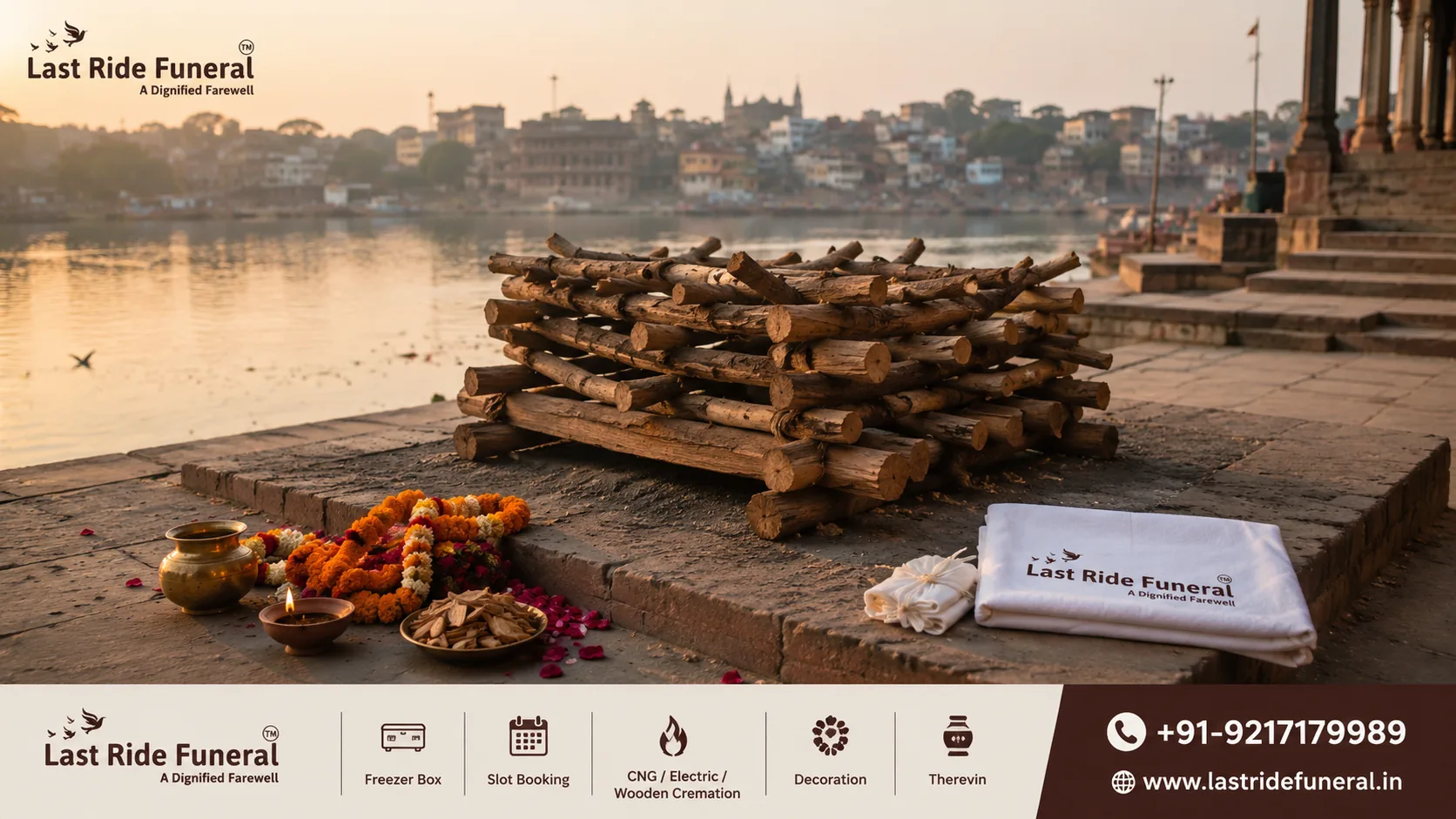
| 24/7 Helpline — 9217179989 | 60-Min Hearse Dispatch | Vedic Samagri Kit Delivered Sealed | Written Quote Before Departure |
|---|---|---|---|
★ 4.9 (5,000+ families served) · 15+ years serving Delhi NCR · 24×7 emergency response
4.9 / 5 based on 412 verified Google reviews
Written by Pankaj Raghav, Director and Co-Founder, Last Ride Funeral Service — last updated 04 September 2026. Our on-ground team has personally coordinated more than 1,600 traditional wooden cremations at Nigambodh Ghat, Lodhi Road, Punjabi Bagh, Shiv Shamshan and Antim Niwas over the past 18 years. Our Delhi coordinator, Joginder, mans the Nigambodh desk from our Raghubir Nagar hub every single night.
The Call That Usually Comes at 3 AM
Most families do not plan for this call. It arrives in the middle of the night, or during a quiet Sunday lunch, or ten minutes after a doctor has stepped out of a hospital room in Kashmiri Gate. And within minutes of that call, someone has to answer a question no one wants to face — where will the antim sanskar happen, and will it be done properly, on wood, the way our elders would have wanted?
The reason you probably landed here typing wooden funeral service at Nigambodh Ghat into a phone is that the answer to that midnight question actually matters. Nigambodh sits on the western bank of the Yamuna near Kashmiri Gate — the same stretch of river where, according to the Puranas, Lord Brahma recovered the Vedas after a ritual snan. For a Vedic traditional wood cremation Nigambodh Ghat rite, there is no more spiritually anchored ground in North India. Below is exactly what unfolds on the ghat, the samagri that goes into the pyre, the real 2026 price band, and how our on-call desk pulls it together inside the two-hour window most grieving families have.
Why Families in Delhi Choose Us for a Vedic Pyre at Nigambodh
Below is the honest version — the fears families actually voice at 2 AM, and how our desk resolves them.
| The worry, in the family’s own words | What Joginder’s desk actually does |
|---|---|
| “How much lakdi — what if the pyre goes cold halfway?” | Weighed on our Raghubir Nagar scale before the truck leaves. 320 to 360 kilos of mango or peepal, priced at that morning’s mandi rate. No under-quoting to win the call. |
| “Will the price at the gate match the price on the phone?” | Every quote is a WhatsApp document with line items and Joginder’s name signed at the bottom. Whatever’s on that page is what’s on the receipt. |
| “Can we even get a Nigambodh slot at this hour?” | The MCD office inside the ghat runs 24 hours. One call from us holds a specific platform number while your van is still turning off Ring Road. |
| “Who chants the mantras — and can they follow our tradition?” | A ghat-fluent shastri rides in the samagri truck. If your family needs Bengali, Marathi, Tamil or Marwari recitation, tell us on the call; we’ve matched all four in the last quarter. |
| “MCD forms, hospital paperwork — we can’t handle this today” | Joginder walks into the counter with the papers, gets the platform slip, and returns the ash-collection receipt to your hand. Family stays with the body, not in a queue. |
What “Lakdi Antim Sanskar at Nigambodh Ghat” Actually Involves
Nigambodh Ghat has dedicated open-air platforms for traditional wooden pyres, arranged along the Yamuna riverfront so the smoke and prayers rise over the water — the way Vedic texts intended. It’s one of the few grounds in Delhi where you can perform the full hindu wooden cremation process on the actual river bank, not in an enclosed chamber. The ground is managed under the MCD (Municipal Corporation of Delhi) portal and has been in continuous use for centuries.
A lakdi antim sanskar Nigambodh Ghat rite involves fire kindled from seasoned wood, ghee, camphor and havan samagri — not a mechanical burner. Families choose it for two reasons: shastra-based custom, and the specific spiritual weight of the Yamuna site. The ground has separate zones for wood-pyre, CNG and electric — meaning wooden cremations are not queued behind mechanical ones.
Nigambodh Ghat — Location, Timings & Vehicle Access
Nigambodh Ghat is on Ring Road, opposite the Yamuna Bazar, roughly 700 metres from Kashmiri Gate Metro Station (Exit 3 is closest). Approximate driving times: 8 km from Connaught Place (25 min off-peak), 12 km from Lodhi Colony (35 min), 18 km from Punjabi Bagh (40 min), 25 km from Gurgaon Cyber Hub (75 min).
The ghat operates round the clock, but the practical wooden-pyre window is 6:00 AM to about 10:00 PM — after that, night rites continue but the samagri stalls near the gate shut around 9 PM, so if you arrive later you’re depending on whatever the family carries in. That’s a detail we build into every dispatch call.
From field experience: At 1:40 AM in July 2026, we handled a wood-pyre cremation for a family arriving from Model Town. The gate was open, the platform was assigned in 12 minutes, but the pooja stall by the arch had shut at 21:15. Because Joginder had loaded the samagri kit from Raghubir Nagar before dispatch, the rite began at 2:05 AM without the family losing an hour hunting for camphor. If you are calling us after 9 PM, do not stop at any Yamuna Bazar shop — call us first, we’ll bring everything.
The Vedic Wooden Cremation Process at Nigambodh — Step by Step
The hindu wooden cremation process at Nigambodh follows a specific Vedic sequence. Understanding it in advance takes some of the edge off the day.
- Snan and vastra — At the home or the hospital mortuary, the body is bathed with warm water, dressed in fresh unstitched white cotton (for male) or the sari the family has chosen (for female), and marked with tilak, tulsi patta and chandan.
- Antim yatra — The arthi is placed in the hearse van and driven from your address to the Nigambodh main gate on Ring Road. On the way, family members chant “Ram naam satya hai.”
- Registration at the MCD counter — Joginder walks in with the hospital death summary, the deceased’s ID proof, and the informant’s ID. The pyre-platform slip is issued in under 20 minutes on a normal day.
- Chita preparation on the platform — The ghat’s karamcharis build a criss-cross wooden lattice around 4.5 feet long and 2 feet high. The deceased is then lifted onto it, head pointing north and feet toward the south — the direction the Garuda Purana assigns for the atma’s journey.
- Samagri layering and mantras — Ghee, havan samagri, camphor tablets, sandalwood chips, cloves, kesar and cotton wicks are placed around the body. The pandit chants the Rig Veda verses assigned for antim sanskar.
- Mukhagni — The eldest son (or in modern practice, often the eldest child, including daughters) walks three parikramas around the pyre carrying a burning kush-grass torch, then lights the fire near the mouth of the deceased. This is the moment the rite becomes irreversible.
- Kapal kriya and asthi collection — After roughly 3 to 3.5 hours the pyre finishes. The pandit performs kapal kriya. Families typically return the next morning at 7–8 AM to collect the asthi in a small clay urn we provide.
A full Vedic rite on the ghat, including registration, takes 3 to 4 hours, plus the short return the next morning. If you plan to carry the asthi to Haridwar for asthi visarjan coordination, we can arrange that at the time of collection.
Wooden Funeral Service at Nigambodh Ghat — Transparent 2026 Pricing
The pricing below is what we actually quote in September 2026. There is no ambiguity, and no “call for pricing” curtain — that trick is common in this industry and we don’t play it.
| Package | What’s Included | Starting From (INR) |
|---|---|---|
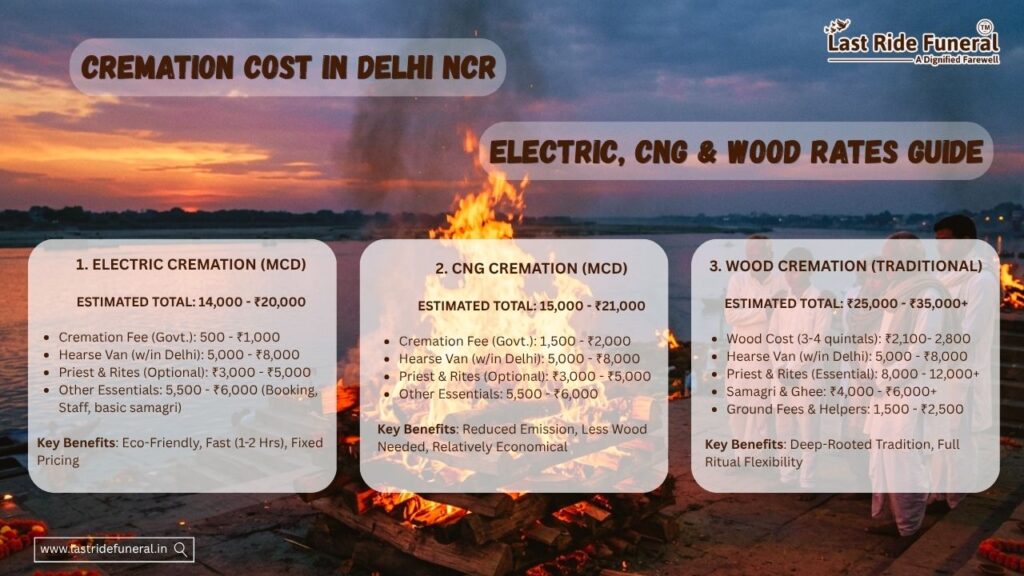
| Basic Wooden Antim Sanskar | ~320 kg seasoned wood, basic samagri kit (18 items), ghat registration assistance, standard hearse within 10 km | ₹19,500 |
| Standard Vedic Package | Wood + full samagri kit (32 items), pandit for Vedic mantras, hearse van anywhere in Delhi | ₹29,500 |
| Complete Antim Sanskar Sewa | Wood + full samagri + pandit + AC hearse + antim yatra flowers + clay asthi kalash + next-morning asthi collection support | ₹44,000 |
| Hearse Van Only (Delhi limits) | Body transport from hospital/home to Nigambodh Ghat | ₹3,800 |
Rates above are the actual entry-point prices we honour in September 2026. Two things move them: the mandi lakdi rate (Yamuna Bazar traders re-price every Monday), and where you’re picking up from — a 40 km pickup from Vasant Kunj adds fuel time we can’t hide. Your written WhatsApp quote lists every line item, and it locks the moment Joginder sends it. GST extra where applicable. Post-10 PM dispatches carry a small night differential on the hearse only.
If you want a numbered quote before deciding, dial 9217179989. Joginder or the on-shift Nigambodh coordinator will confirm the figure to your WhatsApp inside two minutes.
Samagri List for Antim Sanskar at Nigambodh — What’s in the Kit
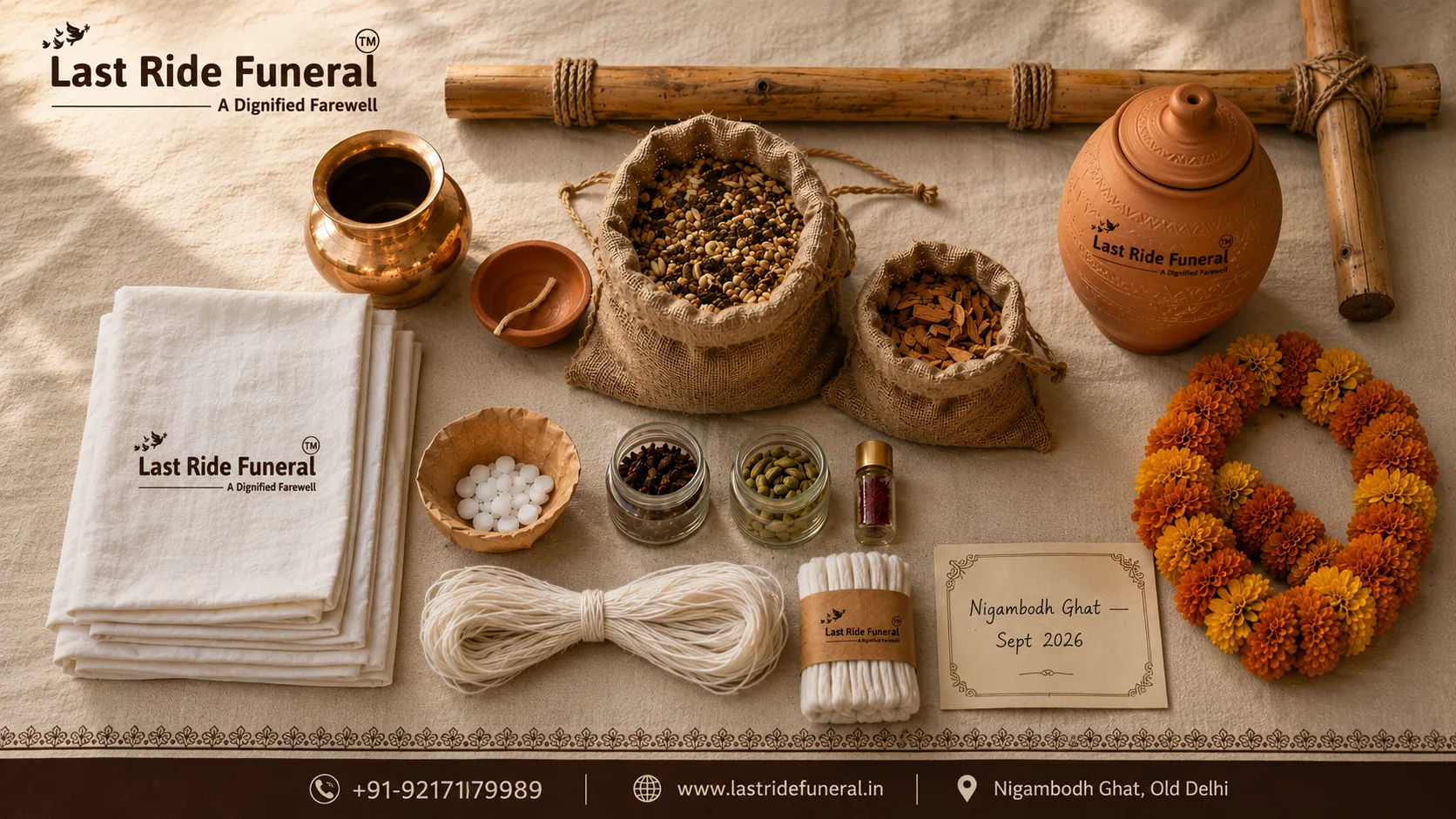
Some families prefer to gather the samagri themselves — often the eldest son wants to feel he has personally arranged it. If that’s your intent, here is the map we hand out over WhatsApp, walked in the order a north-Delhi family would actually drive on the day:
- Lakdi (wood), 320–360 kg — the licensed traders operate inside the Nigambodh compound on the left of the main entrance. They quote per kilo and re-weigh in front of you; do not accept a bundle quoted “as-is.” Mango is preferred over peepal for a cleaner burn.
- Ghee — 2.5 to 3 kilos of pure desi ghee. Nataraj Dairy near Kashmiri Gate has been the reliable source for years; supermarket ghee (adulterated with vanaspati) will smoke and delay ignition.
- Kafan cloth — 5.5 metres of unbleached white cotton, unstitched. Kashmiri Gate cloth market (near Old Delhi Railway Station side) sells the correct grade; ask for “antim sanskar kafan,” not tailoring cotton.
- Havan bundle — a pre-mixed set of guggul, jau, til, gugal-dhoop and dry rice. Kinari Bazar in Chandni Chowk stocks the north-Indian mix; the wooden pyre needs the Vedic version, not the general havan kit.
- Fragrant additions — sandalwood chips (100 g), camphor tablets (100 g), whole cloves (25 g), elaichi and a small vial of kesar. Chawri Bazar’s larger pooja bhandars carry the full set under one roof.
- Ritual items — a bamboo arthi (usually assembled on the spot near the gate), a copper jal-patra, a mitti diya, and pure cotton wicks. The two shops immediately outside the Nigambodh gate assemble these while you wait — but their shutters come down by 9 PM sharp.
- Flowers — marigold garlands and loose rose petals for the arthi. If the rite is a morning slot, the Ghazipur Phool Mandi (2 km east) is fresher and half the price of gate-side vendors.
If any of that reads like a full day’s work, that’s because it usually is. Our sealed antim sanskar samagri kit removes it — every item counted, weighed, and packed the night before by the same person who packs Joginder’s kits every day.
What Papers to Carry Into the Nigambodh Office
The MCD counter here sits inside a small yellow-painted office on the right of the main gate. The clerk in charge is old-school — no papers, no platform allotment. On a busy Saturday morning, we’ve watched families turn back home because they forgot one ID. Here’s the exact list, in the order the clerk asks for it:
- The hospital’s original death summary — signed by the treating doctor with cause of death and the hospital stamp. If the person passed at home, the family physician’s letter carries the same weight, but it must state cause and be on his letterhead.
- MCD Form 4A (death intimation slip) — this is usually issued by the hospital along with the summary; if it wasn’t, don’t panic, Joginder walks it through the on-site MCD desk while you sit with the body.
- One government photo ID of the person who passed — Aadhaar is easiest; passport or voter card also work. Xerox is fine as long as it’s clean.
- One government photo ID of the karta (informant) — this is whoever will sign the register, usually the eldest surviving male, though we’ve seen daughters, wives, and grandsons sign in the last two years with no issue.
- Two witnesses’ names and mobile numbers — friends of the family or neighbours who came to the ghat count. They don’t need to be blood relatives.
The proper death certificate is a separate process handled after cremation. You apply through the Delhi e-District death registration portal, and the central record ends up in the Government of India Civil Registration System. Joginder pings the exact form links and the scanned document list to your WhatsApp within 60 minutes of the rite finishing — the certificate itself takes 7 to 21 working days, and we track the application till it’s downloadable.
Why Nigambodh, and Why Wood — The Vedic Reason
Families sometimes ask why we still recommend the wooden pyre when CNG and electric are cheaper and faster. The short answer: the Rig Veda’s antim sanskar mantras are meant to be chanted while agni — real fire, kindled from wood and ghee — consumes the body. Mechanical cremation is permitted under the shastras when wood is unavailable, but where wood is available, the traditional rite is considered spiritually more complete. Nigambodh sits on the Yamuna, and its historical association with Brahma’s own snan makes it the ghat many Delhi families instinctively pick when they want a Vedic rite done properly.
That said — we don’t push the wooden route on anyone. If your family prefers a mechanical option, we run a full CNG cremation booking near central Delhi service too. And if the family is still en route from Mumbai or Chennai, a freezer box rental for outstation family buys you the 12–36 hours you need without any pressure to rush the rite.
A Family We Helped — A Bengali Wood-Pyre at Nigambodh on 12 August 2026
At 11:20 PM on 12 August 2026, a family in Chittaranjan Park called Joginder. Their grandmother had passed at home an hour earlier. They wanted a full traditional pyre cremation Nigambodh Ghat Delhi rite — but with Bengali Vedic mantras, and they didn’t know a Bengali pandit in Delhi.
Our second vehicle picked up Panditji Chakraborty from Chittaranjan Park itself at 11:55 PM. The hearse van reached the family home at 12:10 AM. Joginder called the Nigambodh MCD counter and held platform number 7 for a 1:40 AM slot. The wood, samagri and Bengali havan bundle were pre-loaded from Raghubir Nagar. Antim yatra reached the ghat gate at 1:22 AM. Mukhagni was performed at 1:47 AM by the grandson, with Panditji Chakraborty chanting in Bengali. Asthi was collected the next morning at 7:30 AM. Total time from the family’s first call to the pyre being lit: 2 hours 27 minutes.
That is what a coordinated Vedic rite at Nigambodh looks like when the desk is ready and the samagri is loaded before the vehicle rolls.
What Families Say About Our Nigambodh Ghat Wooden Cremations
“My father passed at Sunder Nagar and I wanted him cremated at Nigambodh on the Yamuna — the way my grandfather was. Their team arrived in 48 minutes, brought seasoned peepal wood, a full samagri kit and a Sanskrit-fluent pandit. Everything was written down before the vehicle left. I did not make a single second phone call.”
— Aditya S., Sunder Nagar, New Delhi“We are a Marathi family in Karol Bagh and we needed a pandit who could chant our specific gotra mantras at Nigambodh. Joginder called back within four minutes with a name and a photograph. The rite was done exactly as our elders would have wanted.”
— Meera D., Karol Bagh, New Delhi
Questions Families Ask Us Most
What is the price of a wooden funeral service at Nigambodh Ghat right now?
Our entry package for a Vedic lakdi rite at Nigambodh is ₹19,500 (September 2026). The full Vedic Sewa — wood, samagri, pandit, AC hearse, kalash and next-morning asthi coordination — starts at ₹44,000. Two variables shift the number: the weekly mandi rate on seasoned wood, and how far the hearse has to drive to your pickup. Call 9217179989 and ask for a WhatsApp quote; it lands with itemised lines, not a lump sum.
How much lakdi does a Vedic adult cremation actually need?
Between 320 and 360 kilos of seasoned mango or peepal, weighed properly. Younger, less-shrunk bodies burn faster on 300 kg; older bodies with heavier bone mass sometimes need the full 360. Our standard bundle is pre-weighed on our yard scale in Raghubir Nagar before the truck leaves — no one runs out of wood halfway through a rite on our watch.
When is Nigambodh open for a wooden pyre — is night cremation allowed?
The gate is manned 24 hours. In practice, wood-pyre rites happen between 6 AM and about 10 PM because the pooja shops around the ghat shut by 9 PM. Later slots are permitted, and we do run them — but only when we’ve pre-loaded every samagri item from our own yard. Do not try to buy anything at the gate after 9 PM; you’ll be turned away.
Can I gather the samagri myself, or is it easier to take yours?
Both work. Chandni Chowk, Chawri Bazar, Kinari Bazar and the Nigambodh gate shops between them stock every item. Realistically it’s a half-day errand run — three separate markets, wood weighing, ghee sourcing — done during grief, at short notice. Roughly nine out of ten families take our pre-packed kit for that reason alone. Whichever you choose, the guide above tells you exactly where to go.
Do you send a pandit — and can you match our regional tradition?
Yes to both. A shastri who knows the Nigambodh ritual sequence travels with the samagri vehicle by default. If your family follows a specific regional tradition — Bengali, Marathi, Tamil, Marwari, Odia, Bihari — mention it when you call. In the last quarter alone we’ve matched Bengali families to Panditji Chakraborty, Marathi families to a Pune-trained shastri living in Karol Bagh, and a Tamil Iyer family to a Chittaranjan Park priest.
Does Nigambodh work for a family that isn’t originally from Delhi?
It’s arguably the most cross-community ghat in the city. Bengali, Punjabi, Marwari, Marathi, South Indian and Bihari families cremate here every week, precisely because the Yamuna-riverfront association carries Vedic weight in every regional tradition. If you’d like to compare grounds, our wooden funeral service at Lodhi Road guide covers the central-Delhi alternative in the same level of detail.
How long am I actually at the ghat on the day?
Plan for 3 to 4 hours from arrival to leaving. Registration eats the first 20–40 minutes depending on the queue, chita building takes another 40, mantras and mukhagni run about an hour, and the initial burn is where the last chunk goes. You’ll come back the following morning at 7 or 8 AM for a 15-minute asthi collection — Joginder confirms the exact time before you leave the ghat.
One Number, Any Hour
The most useful thing you can do next is dial 9217179989 and ask for Joginder. A live person picks up inside 30 seconds — no menu, no “your call is important to us,” no waiting. In that first minute we take the pickup address, the ghat you’d prefer, and any regional tradition we need to match. Within the next few minutes you’ll have the platform held at Nigambodh, the hearse rolling out of Raghubir Nagar, and a written, line-itemed quote sitting in your WhatsApp for confirmation.
Last Ride Funeral Service
Shop At Flat No. A-28-A, Ground Floor, Raghubir Nagar, Behind Shivaji Collage, New Delhi 110027
Phone (24/7): 9217179989
Website: https://lastridefuneral.in
Email: info@lastridefuneral.in
Instagram: https://www.instagram.com/lastridefuneralservices/
Facebook: https://www.facebook.com/lastridefuneral/
X (Twitter): https://x.com/lastridefunral/

Comments