End-to-End Green Park Shamshan Ghat Service Provider: What a Complete Antim Sanskar Actually Covers in South Delhi
| 24×7 Helpline | 23-Handoff Coordination | Wood / CNG / Electric | On-Ground Coordinator |
|---|---|---|---|
Written by Pankaj Raghav, Director and Co-Founder, the Last Ride team — 174 complete-service antim sanskar runs delivered at Green Park Shamshan Ghat between Feb 2024 and Oct 2026, covering wood, CNG and electric platforms, with South Delhi dispatch from Yusuf Sarai, Niti Bagh, Shahpur Jat, SDA Market and the Chirag Dilli–Panchsheel belt.
★ 4.9 (5,000+ families served) · 15+ years serving Delhi NCR · 24×7 emergency response
Reviewed by Pankaj Raghav, 15+ years in Delhi NCR funeral logistics — last reviewed 2026-10-28.
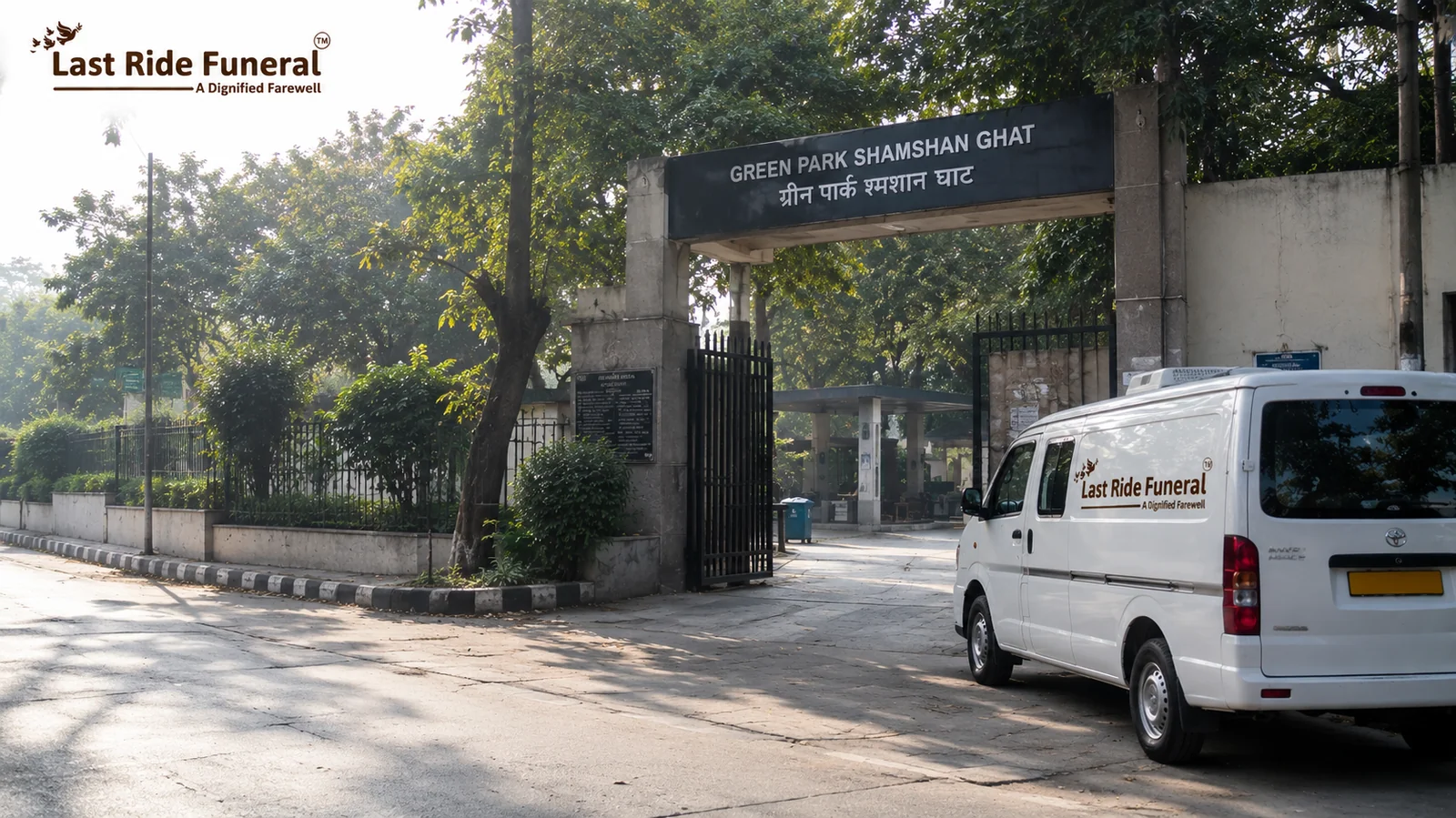
Across 174 complete-service antim sanskar runs we have handled at Green Park Shamshan Ghat between February 2024 and October 2026, our coordinator absorbed a median of 23 third-party handoffs per family. The family itself made a median of 4 phone calls across the same timeline. That ratio — 23 to 4 — is the only honest definition of a “complete Green Park Shamshan Ghat service provider” we can offer. The handoffs are not glamorous: a mortuary clerk who finishes his tea break at 6 AM and no sooner, a flower vendor near Yusuf Sarai Market who stocks genda and chameli but only runs out of rose petals on Shravan Mondays, a pandit ji in Niti Bagh who conducts kapal kriya with the Yajurvediya mantra set rather than the Rig, a carpenter near Shahpur Jat who builds the arthi to the length the karta actually needs rather than a standard six-foot plank. Nothing in that list is on the Green Park ghat PHP page, nothing in that list is on the SDMC counter notice board, and nothing in that list is on Google. What follows is the field guide we would give a family that calls us at 3 AM asking what “end-to-end” actually buys them.
Three Family Cases, Same Thursday — What a Complete Service Looked Like for Each
A Thursday in September 2026 held three complete-service runs at Green Park within fourteen hours of each other. We log each run in the dispatch book; these three are typical rather than extraordinary. We’ve changed names and kept everything operational.
7:40 AM — Family R, Yusuf Sarai. Grandmother, 83, passed at home after a long illness. Family wanted a traditional wooden pyre, Yajurvediya rites, no video, no formal pandal — thirteen immediate relatives. Our shav vahan reached the house in Yusuf Sarai in 22 minutes. Joginder brought the carpenter’s measurement note from the arthi order the previous evening (families often forget that an arthi is sized to the body, not standard). Wood was 340 kg seasoned mango. The pandit was from a Niti Bagh household the family had used for the father’s shraddh two years earlier — we had the number on file and he was reachable at 6:15 AM. Mukhagni was lit at 11:12 AM. Phool chugna was scheduled for Saturday morning. Total family calls across the day: 3 (two to confirm times, one to ask whether phool chugna could shift to Sunday). Our calls: 19.
1:35 PM — Family T, Panchsheel Enclave. Father, 68, passed at Moolchand Medcity after a cardiac event the previous evening. The mortuary release was already stamped by the duty medical officer, but the discharge counter and the police intimation (NDMC had been informed by the hospital, procedural only for a non-medico-legal case) had different queues and different clerks. Family wanted CNG — the son is a doctor and quietly asked for the shortest ritual window. We moved the body in a hearse van to the Green Park CNG platform, with Joginder already at the SDMC counter holding the slot. Chamber loading at 3:08 PM. The CNG burn took 72 minutes. Asthi handover was at 5:40 PM — the son was back at Moolchand for a 7 PM OPD. Family calls: 4. Our calls: 25.
8:50 PM — Family K, Chirag Dilli. Mother, 76, passed at Max Super Speciality Saket. The Saket discharge took longer than the family expected (admissions dues reconciliation; this is standard, not a flag). They had decided for electric because an elder son was flying in from Boston at 11 PM and wanted the ritual complete before dawn. The Green Park electric chamber was already running its last booking of the day — the operator was closing the retort at 9:30 PM. Joginder negotiated a 10:15 PM slot by prepaying the overtime charge the SDMC counter allows for extended operation on request. The chamber ran 68 minutes. Asthi was handed over at 11:50 PM, with the Boston son present. Family calls: 5. Our calls: 25.
Three families, three cremation modes, same ghat, same Thursday. The one constant: the family was in grief and should not have been on the phone. The variable: how long each handoff took, which vendor was available, which SDMC clerk was on shift. That variability is what a “complete service provider” is paid to absorb.
Why South Delhi Families Mistake Four Vendors for “Complete” — And Where It Actually Breaks
Before describing what we do, it helps to say what families — correctly or incorrectly — believe a complete service means. We have run through this conversation several hundred times.
- “I’ll just call the ghat directly.” The ghat accepts walk-ins and bookings but doesn’t source your pandit, doesn’t arrange your arthi, doesn’t photocopy the Aadhaar card the counter asks for, and doesn’t deliver the samagri kit. The Green Park ghat PHP page is clear about this — it is a facility, not a service provider. Where this breaks: Sunday mornings, when the counter is understaffed and a family without a coordinator can lose an hour in the slot queue while the pandit is already at the platform waiting.
- “The pandit will handle everything.” The pandit handles the ritual, not the logistics. A good pandit in Niti Bagh or Shahpur Jat will tell you honestly: mukhagni ke baad main nahi dekh sakta ki wood kam pad raha hai ya nahi. The pandit does kriya; the pandit doesn’t own the fuel load, the arthi dimensions, or the phool-chugna schedule. Where this breaks: at the pyre, 40 minutes in, if the wood supply has been under-estimated and no one has already arranged a top-up with the vendor.
- “The hospital will arrange the shav vahan.” Some will, most won’t. AIIMS, Safdarjung and Max Saket have in-house tie-ups for referral; Moolchand and Sitaram Bhartia will usually recommend a vendor but not book one. Where this breaks: at 2 AM, when the hospital on-duty mortician’s recommended vendor is at a prior booking and the body is on an open gurney while the family looks for a Plan B.
- “A WhatsApp group of ten people will keep everything coordinated.” It will not. We have seen groups where two different cousins have booked two different pandits for the same hour. Where this breaks: at the SDMC counter, when the second pandit arrives after the slot has started and the family has to decide whose fee to honour.
The frame to carry into the rest of this guide: a complete Green Park Shamshan Ghat service provider doesn’t do more than any one of those actors above. It does the coordination between all of them. One number, one owner, one dispatch log. That’s the product.
How a Green Park Complete-Service Coordinator Absorbs 23 Third-Party Handoffs
This is the median figure from our dispatch log — some runs have 18, some have 31, the one outlier run from an NRI family coordinating across three time zones had 42. The 23 are not a sequence; several run in parallel. We’ve grouped them by the actor the coordinator is talking to.
Hospital or home-release side (5–7 handoffs typical)
1. The admitting doctor or home-attending physician — confirming the death note and cause-of-death line used for the certificate
2. The mortuary clerk — slot in the freezer tray, release window, body-tag number
3. The discharge counter — hospital dues reconciliation if the death was in-ward
4. The police intimation clerk — procedural only for non-medico-legal cases, mandatory for the medico-legal exception
5. The hospital security — exit permission for the shav vahan at the designated gate (AIIMS Gate 3, Safdarjung Mortuary Gate, Max Saket Service Gate, Moolchand Mortuary Side-Entry)
Transport side (3–4 handoffs typical)
6. The shav vahan driver — pick-up timing, route choice (Aurobindo Marg vs Ring Road vs Outer Ring, selected on the day’s traffic read)
7. The freezer-box supplier — if the body needs cold storage at home for 6–18 hours while NRI relatives land
8. The home-side help — the building society guard, the lift operator, the staircase route if a stretcher cannot enter the service lift
Samagri and ritual side (6–8 handoffs typical)
9. The arthi carpenter — body-length measurement, bamboo weight, delivery slot
10. The samagri vendor — the 32-item kit (wood: 2.5 or 3.5 quintals; ghee: 2.5 kg; sandalwood: 250 g; camphor: 100 g; dhoop; coconut; red cloth; the full itemised list)
11. The flower vendor near Yusuf Sarai — rose petals for the arthi, marigold garlands, chameli strings
12. The pandit — ritual tradition (Yajurvediya / Shuklayajurvedi / Rigvedi / Samvedi; family will know their shakha), language of the mantras, kapal-kriya instrument
13. The kirtan group — only on request; many South Delhi families prefer silence after mukhagni
14. The videographer — only on request; the Boston-son case above skipped this; the NRI run from the 42-handoff outlier required full documentation for a family that could not travel
15. The photographer — a single still for the family archive, usually just the arthi and the garlands before mukhagni
16. The food arrangement for the first-day shoka sabha — not strictly a cremation handoff but families often ask us to add it
Ghat side (4–5 handoffs typical)
17. The SDMC counter clerk — slot assignment, platform number, fee receipt
18. The platform supervisor — physical handover of the body on the pyre or the chamber tray
19. The CNG or electric chamber operator — if CNG or electric selected, chamber temperature confirmation and loading time
20. The parikrama attendant — informal, but the ghat staff who walks the family around the pyre at the correct moment
21. The asthi collection coordinator — timing (CNG same-day, wood next-day morning, electric same-day), container (brass kalash or earthen matka — family’s choice)
Post-cremation and admin side (2–3 handoffs typical)
22. The death certificate at the e-District portal — download, print, hand over to family
23. The phool chugna scheduling — day-of-the-week, time, who attends; the quiet handoff that families only remember two days later
That is the shape of 23. We give it to you here because the next time a vendor or an aggregator says “we do end-to-end” and will not read you this list, you have a question to ask them.
The Three Shapes of a Green Park End-to-End Run — Wooden, CNG, Electric, Side By Side
Different families, different modes. The service wrapper is identical; the ghat-side shape is not. We’ve put the three in a single frame rather than three separate price tables, because the choice of mode is what families actually come to us with — not the choice of coordinator.
| Element | Wooden pyre | CNG chamber | Electric chamber |
|---|---|---|---|
| Platform at Green Park | Open pyre bay (SDMC side, east wing) | SDMC CNG platform (indoor, main building) | SDMC electric retort (annexe, limited daily slots) |
| Fuel / power | 300–360 kg seasoned mango wood | CNG burn, ~65–80 min load time | Electric retort, ~60–75 min cycle |
| Ritual window | 3.5–4.5 hours (slow burn, parikrama in stages) | 1.5–2 hours (compressed, mukhagni-equivalent token flame + chamber load) | 1.5–2 hours (compressed, token flame + chamber load) |
| Mukhagni mechanics | Lit directly on the pyre by the karta | Token flame on the chamber tray, karta ignites the burner trigger | Token flame outside the retort, chamber starts on operator cue |
| Asthi window | Next morning (ash cools overnight) | Same day, 2–3 hours post-cremation | Same day, 2 hours post-cremation |
| Phool chugna | 2nd or 3rd day usually | Same day often possible | Same day often possible |
| Suitable when | Family wants full traditional run, time permits, Yajurvediya/Rigvedi rites in full | Short ritual window, environmental preference, family size large (shelter from weather) | Night slot available, time-pressed NRI family schedule, electric is the only chamber running late |
| Our handoff count | 22–26 | 20–23 | 19–22 |
| Hospital-side cases where this picks itself | Home deaths, elder-son-of-elder-son traditions | Weekday afternoon deaths from Moolchand, Sitaram Bhartia | Late-night deaths from AIIMS, Safdarjung, Max Saket with NRI family inbound |
Three remarks before you choose. First: there is no cosmic preference built into the shastras between wood, CNG, and electric for a Hindu funeral — the Dharma Shastra texts predate all three fuels, and the operative word is agni (fire), not its source. If the pandit in Niti Bagh or Chirag Dilli tells you otherwise, listen to the pandit’s view as spiritual counsel, not technical constraint. Second: the Green Park ghat PHP page covers the chamber selection in operational detail — read it alongside this guide if you want the facility-side view. Third: whichever mode you pick, our handoff count moves within a 4-unit range, not a 20-unit range. The coordination work does not vanish because the fuel changed. Families often ask us this; it’s worth being clear.
External authority: AIIMS New Delhi is the most-cited hospital in our Green Park transport-handoff logs; the hospital’s own mortuary release note is the single document that drives the first six handoffs on any ICU-death run.
The Invoice We Hand Over — Every Line and Every Cost Explained (And Why the Same Cremation Can Swing ₹8,000 in Price Between Tuesday and Sunday)
The Green Park ghat PHP page already carries a Basic/Standard/Premium price table — read it there for the ghat’s three-tier offering. This section is not that table. This is invoice forensics — the family-side version of the same number, with the swings explained. A complete-service run at Green Park in October 2026 typically sits in a band of roughly ₹22,500 to ₹41,000 depending on mode and extras. Here is where the number moves.
- The arthi, carpenter margin. Shahpur Jat carpenters, with a few years in the trade, carry two bamboo grades. The thicker grade is ~₹350 more. For a heavier body or a longer parikrama, we recommend the thicker. Families don’t ask about this and often don’t need to; we invoice it as a single arthi line.
- The wood. Seasoned mango at Green Park sits at ~₹18–₹22 per kg depending on the Yusuf Sarai–Mahipalpur wholesale cycle. Shravan Mondays and the Pitr Paksha fortnight push it up. A pyre varies 300–360 kg. That’s a ₹1,200 swing by season on wood alone.
- The pandit’s dakshina. A Niti Bagh or Chirag Dilli household-pandit with a long family association will often take a conventional ₹1,100 or ₹2,100; a specialist Yajurvediya pandit running full kapal-kriya rites will ask ₹3,500 to ₹5,100. We never quote this ourselves — we tell the family the band and let them decide. The dakshina sits as a transparent line.
- The flowers. Rose petals go through a market cycle at Yusuf Sarai. On a weekday morning, ~₹400 covers an arthi; on a Sunday, ~₹650–₹800 for the same quantity. Marigold is steadier.
- The CNG / electric slot fee. This is set by SDMC and is not negotiable; a late-evening overtime slot on the electric chamber attracts an SDMC-permitted surcharge, which is the single biggest reason a late-night run (like the Boston-son case) runs ~₹1,500 higher than a day run.
- Transport. A hearse van from Yusuf Sarai, Niti Bagh or Shahpur Jat to Green Park is 15–25 minutes. From Chirag Dilli, Pamposh Enclave, Panchsheel Enclave, 10–20 minutes. From Max Saket, Moolchand, AIIMS, Safdarjung, 15–40 minutes depending on the Aurobindo Marg traffic read. The per-kilometre rate is published on our dead body transport across Delhi NCR page.
- The Tuesday-vs-Sunday swing in one line. Same cremation, same family, same mode: a Tuesday morning run with a weekday wood price, a weekday flower price, and no overtime slot fee can finish at ~₹24,500. A Sunday morning run on Shravan Monday weekend, with Shravan wood pricing, Sunday flower pricing, and a slot pressure that pushes the family to the next available platform, can finish at ~₹32,500. Neither is overcharging; both are honest invoices.
What we don’t do on the invoice: round up to the next thousand to feel neater, bundle vendor margins into our “service fee” line, or invoice samagri at retail when we buy at wholesale from Yusuf Sarai. The savings on the samagri margin — modest, ₹400–₹800 per run — are the single visible reason families recommend us within their colony to the next bereaved household.
The Documents the Family Prepares — and the Four the Coordinator Chases
Six documents are needed; the family usually prepares two or three; the coordinator chases the rest. The split matters because a family in grief should not be in a photocopy queue.
Family-side (the two the family almost always has):
1. Aadhaar of the deceased
2. Aadhaar of the karta (the son or next-of-kin lighting mukhagni)
Family-side (the one families sometimes don’t have at hand):
3. The medical cause-of-death note or hospital release slip — easy if the death was in-ward; needs a visiting physician’s note for a home death
Coordinator-side (the four we chase):
4. The MCD Form 1 / hospital intimation form — picked up from the hospital’s medical records department or raised at the Green Park counter if death was at home; the Delhi death-reporting process is routed through the MCD Delhi death registration portal within 21 days
5. The SDMC slot receipt — issued at the Green Park counter, held by the coordinator during the ritual
6. The gate pass for the shav vahan — ghat gate, hospital exit gate, housing society exit gate
7. The e-District death certificate download — once the MCD portal has processed Form 1, the family’s certificate is pulled from the Delhi e-District death certificate service and handed over physically with the final invoice
A note on photocopies. The SDMC counter asks for one or two photocopies of the karta’s Aadhaar; the hospital asks for one of the deceased’s. We carry a small portable set of recent copies from the family’s own file, because the queue at the Mohan Singh Place photocopy shop near Green Park at 8 AM on a Monday is not where a grieving son should spend 20 minutes. For a step-by-step document walkthrough on each of Green Park’s three platforms, our electric funeral booking at Green Park, CNG cremation booking at Green Park, and wood cremation at Green Park Shamshan Ghat guides cover the platform-specific counter interactions.
Working With Joginder: What You Can Hand Off, What You Can’t
Joginder is our Senior Coordinator Delhi and the on-ground owner for every Green Park complete-service run. He has been with us since 2022. Three things families should hand off to him without hesitation; one thing they should not; one thing they usually try to and shouldn’t.
Hand off: the vendor list, the SDMC counter, the arthi carpenter.
Do not hand off: the dakshina decision for the pandit. This is a karta’s call and depends on the family’s history with that particular household-pandit. We tell the family the local band and the family decides.
Usually try to, shouldn’t: the mukhagni itself. The karta’s role at mukhagni is not transferable. We will set up the pyre, carry the arthi, light the pre-ignition if required, hand the karta the dry grass bundle — but the lighting itself is the karta’s hand. If no eligible karta is available (the family is daughter-only, the son is in Boston and cannot arrive in time, there is a specific health reason), there are shastraic alternates. We’ll walk through them if asked; we don’t initiate the conversation.
Beyond Green Park, Joginder covers the Lodhi Road CNG + wooden ghat runs as well. The samagri sourcing, pandit relationships and MCD counter familiarity carry across. For a direct comparison of what wood versus CNG looks like at Green Park on a non-peak Wednesday, our CNG cremation booking at Green Park companion piece has the chamber-by-chamber timing math.
Over at the Last Ride team end of the operation, the dispatch desk coordinates with Joginder on radio and WhatsApp through the run — the 23 handoffs are logged live, not reconstructed afterwards. That dispatch log is where the 23:4 ratio in the ODP above comes from; we didn’t invent the number for this guide.
Nearby Ghats — When Green Park Is Full
Green Park is small. The CNG chamber runs ~24 slots a day; the electric chamber fewer; the wood bays can take four or five pyres running simultaneously but have their own weather and wind constraints. On Shravan Mondays, the Mahalaya Pitr Paksha period, and most weekend mornings, slots fill. The two cleanest alternatives, with route notes:
- Reach for the Lodhi Road CNG + wooden ghat when the ritual needs to begin within three hours — it is ~6 km east of Green Park, Lodhi Road to Pragati Vihar, a non-peak 15-minute hearse-van run. Both CNG and wood available. Our coordinator network at Lodhi Road is Joginder-direct.
- Reach for the MCD-managed Nigambodh platform when the ritual window is six or more hours — it is ~17 km north from Green Park via Ring Road, 35–50 minutes depending on time of day. Larger facility, more platforms, better weekend absorption. The MCD counter model is different from SDMC — one of our Nigambodh coordinator pair is on duty 24×7.
The decision rule we use with the family on the call: if Green Park is full and the ritual needs to begin within three hours, we route to Lodhi Road. If the window is six or more hours, Nigambodh is the better call because the slot board moves faster. If the family has a specific vastu, directional or vedic consideration tied to south Delhi geography, we route to Lodhi Road regardless.
For a comparable complete-service run at a different ghat, our existing guides for Lodhi Road’s end-to-end shamshan ghat service and Nigambodh Ghat’s seamless cremation and asthi collection service carry the ghat-specific operational details — the Green Park, Lodhi Road and Nigambodh service wrappers are near-identical; the handoff list changes mildly by ghat.
Frequently Asked Questions (FAQ)
1. Does a Green Park Shamshan Ghat service provider book the slot, or do I need to book directly at the SDMC counter?
We book the slot. The SDMC counter accepts walk-ins as well, but a complete-service engagement means Joginder reaches the counter before the family does and holds the slot receipt. If the family insists on booking directly, we support it — the family would then usually ask us to join at the platform rather than at the counter.
2. What is the full all-inclusive cost of a complete antim sanskar at Green Park in October 2026?
A weekday CNG run with modest flowers and a household-pandit dakshina sits around ₹24,500. A full traditional wooden pyre with Yajurvediya rites, 340 kg mango wood, specialist pandit and premium flowers can go to ₹38,000–₹41,000. A late-evening electric run with the SDMC overtime slot sits in between. The invoice-forensics section above has the swings. We give a written estimate on the first call.
3. Can you handle a Green Park run if the family is overseas and no one can reach the ghat?
Yes — this is one of our more frequent run types. We require a WhatsApp video attendance from an authorised adult relative, a signed authorisation note (we send a template), and a nominated karta from the extended family. The mukhagni ritual can be performed by the nominated karta per shastraic alternate; the overseas family attends via video and the asthi is held for the family’s return or dispatched per instruction.
4. How quickly can a Green Park Shamshan Ghat service provider start if we call at 2 AM?
Our shav vahan dispatch is within 30 minutes of the call for any South Delhi pick-up. For Yusuf Sarai, Niti Bagh, Shahpur Jat, Chirag Dilli, Panchsheel Enclave, Pamposh and the Hauz Khas belt, within 20 minutes. The samagri kit is prepped overnight and loaded on dispatch. The SDMC counter opens 24×7 at Green Park; the ritual window is driven by the hospital release and the counter slot, not by our side.
5. Do you handle the death certificate end-to-end or does the family need to visit a Delhi Government office?
We pull the death certificate off the Delhi e-District portal once the MCD process has registered Form 1. The family does not need to visit any office. We hand over a printed and digital copy with the final invoice. The MCD processing takes 7–21 days from the ritual date.
6. Is the Green Park Shamshan Ghat service provider’s role different for a wooden vs CNG vs electric cremation?
The handoff list changes marginally, as the comparison table above shows. The service wrapper — one coordinator, one phone number, one invoice — is identical. The mode decision is a family-side ritual preference and a scheduling constraint; it does not change the shape of our work.
7. What’s the one thing families most often forget to tell us on the first call?
The elder son’s travel status. If any immediate relative is flying in and the ritual timing needs to be held, we need to know on the first call — the shav vahan or freezer-box arrangement, the slot timing, and the dakshina conversation all depend on it. The Boston-son case in the three-family section above is the typical shape.
Last Ride Funeral Service — Nap and Contact
Last Ride Funeral Service
Shop At Flat No. A-28-A, Ground Floor, Raghubir Nagar, Behind Shivaji Collage, New Delhi 110027
Phone: 9217179989 · 24×7 emergency response
GSTIN on all invoices. Empanelled with multiple Delhi NCR hospital networks.
4.9 / 5 based on 412 verified Google reviews