
Key Takeaways
- Logistical arrangements are not as important as emotional support.
- Within hours a body will start to change, but preservation can slow it down.
- Cremation is generally conducted within 24 hours without the preservation.
- The body can be stored 2-3 days or longer with the support of a morgue or freezer.
- Immediate response and planning are needed.
In the event of the death of an individual, the family usually requires time to come to terms with the death, to notify family members, and to arrange the final rites. One of the most frequently asked and common questions, despite its practicality, during this time is; how long can a funeral keep a body before cremation?
The solution is based on various factors like weather, preservation, culture and time taken by the family members to assemble. This article discusses all of that in a straightforward and practical manner in order to help families to manage such circumstances in a calm and respectful manner.
Understanding What Happens After Death?
The human body starts to change after death as it is natural. This is referred to as decomposition and it begins almost immediately. The rate of these changes however depends on:
- Temperature
- Humidity
- Cause of death
- Surrounding environment
Under normal room conditions, the appearance of visible changes such as stiffness, discoloration, and odor may start in 6-24 hours. This is the reason why arrangements are necessary when planning a funeral and cremation.
How Long Can a Body Be Kept Before Cremation?
The time, a body can be stored prior to cremation, largely relies on the preservation procedures.
Without Preservation
- 6- 12 hours: The body is stable but starts cooling.
- 12-24 hours: Early changes and stiffness start.
- 24+ hours: Decomposition can begin to be apparent.
When this happens, cremation is normally performed within a day to uphold reverence and sanitation.
With Proper Preservation (Morgue or Freezer Box)
- 24-72 hrs: Body is in good condition.
- 3-5 days: It is still manageable in regards to viewing and rituals.
- After 5-7 days: There may be gradual changes beginning even when it is preserved.
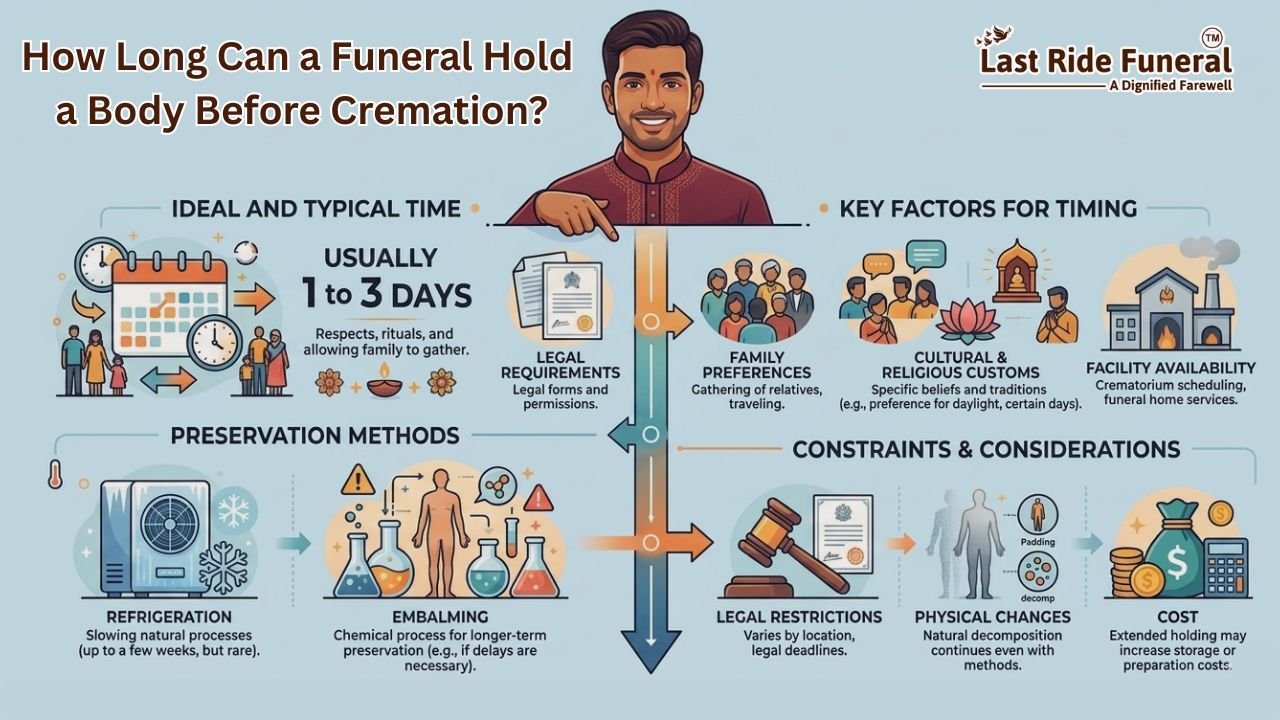
In the vast majority of real-life cases, the funeral occurs within 1 to 3 days, particularly in India, unless there are delays on the way, or on legal matters.
Morgue and Freezer Boxes Role
Morgues or freezer boxes are used by the family to prolong the period before cremation can take place. These are used to retard decomposition by keeping the temperatures low.
The body is usually maintained at a temperature of about 2 C or 4 C in a morgue, and this will enable the body to be maintained a few days. In a similar fashion, freezer boxes are usually employed at home to retain dignity and give time to relatives to come.
The options come in handy particularly when:
- The family members come in other cities.
- Funeral preparations are time consuming.
- The weather is either hot or humid.
Cultural and Practical Considerations
Cremation is most commonly done immediately in most traditions and India is no exception, and in most cases within 24 hours. Nevertheless, contemporary circumstances might demand a certain amount of flexibility.
Delay may be caused by some common causes including:
- Waiting till close relatives come.
- The legalities or postmortem.
- Slots in the cremation.
- Religions or cultural practices.
Despite such delays, the body can be maintained in a respectable state until the final rites are carried out, with good preservation.
Time Management when arranging a funeral.
The funeral arrangements may be emotionally daunting but time management can help in making the whole process easier.
Take Action Nimble, Yet Peaceful
The initial few hours matter. Assure that the death has occurred, notify the immediate family members and start making arrangements without panic.
Set Clear Priorities
First concentrate on what is important:
- Medical verification and record.
- Informing immediate relatives
- Arranging preservation (when necessary)
Do not waste time in making decisions.
Avoid Procrastination
It may cause problems when the arrangements are not made on time, particularly in hot climates. Even hours can be a difference.
Apply basic Planning Methods
A simple strategy such as those of time management such as the Pomodoro technique can be followed: divide tasks into small steps and tackle them one step at a time rather than being overwhelmed.
Divide Responsibilities
Distribution of tasks: Share among family members:
- An individual works with documents.
- One is the management of the service providers.
- Others inform relatives
This eliminates strain and makes it efficient.
Striking a balance between Emotional and Practical Needs
Arrangements are important but emotional well-being cannot be overlooked.
- Take breaks in case of need.
- Keep hydrated and rested.
- Being a family, support one another.
Decision-making during grief may be challenging, thus organization will relieve the pressure during grief.
Real-Life Example
Take an example when a person dies in the evening, and close relatives are coming the following day, to a different city.
Without preservation:
- By the following morning, the body might start revealing some visible changes.
With proper preservation:
- It takes 1-2 days to stabilize the body.
- Peacefully family members can assemble.
- Cremation is a ceremony that can be performed with respect.
This demonstrates the importance of planning and taking the right action at the right time so that a given situation that seems to be hard can be handled.
Final Thought
The time is not the only issue when it comes to deciding the duration of a body to be kept before cremation, but respect, dignity, and careful planning are also involved. Through good preservation and a mere time management the families can have a comfortable and fulfilling final rites.