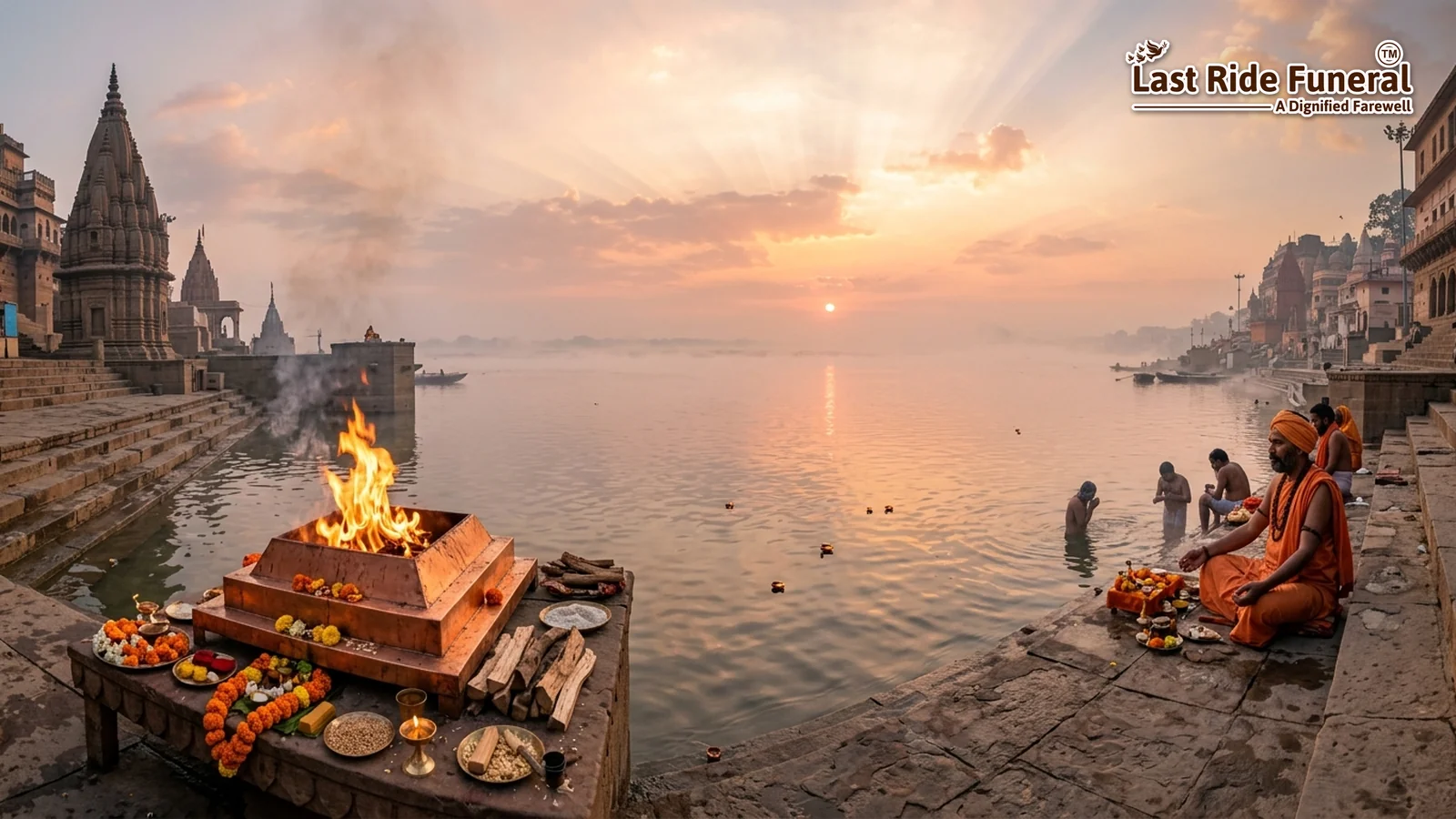
Dissolving Back into the Five Elements: Vedic Cremation and the Pancha Bhoota
In contemporary Western thought, death is frequently viewed as an abrupt termination, and the disposal of a body as a clinical necessity. In Vedic philosophy, however, cremation is never seen as destruction—it is revered as the ultimate act of cosmic recycling.
According to ancient Hindu metaphysics, the human body is not a permanent possession. It is a temporary organic loan borrowed from the material cosmos. When life departs, the ancient ceremony of Antyesti (the last sacrifice) uses sacred fire (Agni) to rapidly and respectfully return every borrowed component back to its primordial source: the Pancha Bhoota—the Five Great Elements of Earth, Water, Fire, Air, and Space.
At Last Ride Funeral, our coordinators and Vedic scholars regularly assist families across Delhi NCR—from the historic banks of Nigambodh Ghat to the modern facilities at Lodhi Road and Dwarka Sector 24—helping loved ones view the cremation pyre through this transformative and comforting spiritual lens.
The Philosophy of Borrowed Matter
The Taittiriya Upanishad and the Bhagavad Gita (Chapter 2, Verse 22) articulate that just as a person discards worn-out garments and dons fresh ones, the immortal soul (Atman) casts aside worn-out physical bodies.
The physical frame (Sthula Sharira) was assembled molecule by molecule from Mother Earth through nutrition, water, breath, and sunlight. At the conclusion of an earthly life, retaining the physical form serves no evolutionary purpose. Vedic wisdom teaches that holding onto an empty vessel leads to spiritual stagnation and emotional torment. By offering the body to the sacred fire, the family returns nature’s debt with honor, gratitude, and promptness.
How Each Element Dissolves into the Cosmos
During the sacred cremation ritual, the decomposition that would otherwise take decades underground is completed cleanly within hours through consecrated thermal alchemy. Each of the five elements finds its direct cosmic path home:
[Mortal Body]
      │
      ├──> Prithvi (Earth)  ──> Bone residue & sacred ash returning to soil
      ├──> Jala (Water)     ──> Moisture evaporating to clouds & river immersion
      ├──> Agni (Fire)      ──> Body heat merging into the universal thermal continuum
      ├──> Vayu (Air)       ──> Vital breath & gaseous essence joining atmospheric winds
      └──> Akasha (Space)   ──> The collapsed cellular volume merging into infinite space
1. Prithvi (Earth): Bones and Minerals
The solid architecture of the body—calcium, bones, dense tissue, and minerals—constitutes the Earth element. As the wood pyre or CNG chamber reaches peak temperature, these structures are reduced to fine mineral ash and uncalcined bone fragments (asthi). These remnants are later gathered for sacred river immersion or placed in soil, enriching the planetary bedrock from which future flora will sprout.
2. Jala (Water): Fluid and Moisture
Over 65% of the human form consists of water—blood, cellular fluids, and moisture. In the cremation pyre, this water vaporizes, rising skyward to join rain clouds. Later, during the Asthi Visarjan ceremony in the sacred currents of the Ganga or Yamuna, the remaining ash dissolves completely into the world’s waterways, completing the hydrological cycle.
3. Agni (Fire): Body Heat and Energy
During life, biological metabolism maintains the internal flame of digestion and warmth (Jatharagni). When heartbeat and breath cease, the body turns cold as the internal fire wanes. The external fire of the funeral pyre reignites this thermal essence, reuniting the mortal spark with the primal solar energy that sustains all cosmic life.
4. Vayu (Air): Breath and Prana
The respiratory system is powered by the cosmic wind (Vayu). Cellular gases and volatile organic compounds released by the flames are swept upward by thermal convection currents into the atmosphere. The breath that once whispered prayers or laughter recirculates into the troposphere, becoming part of the global air currents that give life to forests and living creatures.
5. Akasha (Space / Ether): The Dimensional Container
The physical form occupied a distinct physical coordinate—a specific height, width, and volume in space. When the elemental bonds dissolve and the physical shell vanishes into ash and vapor, the localized boundary ceases to exist. The space that was once bounded by flesh merges seamlessly with the boundless, unmanifest expanse of universal consciousness.
Agni as the Divine Messenger: Pavamana and Kravyada
In Vedic hymns, Fire is addressed in two sacred aspects:
– Agni Pavamana: The pristine purifier that transforms base matter into refined energy.
– Agni Kravyada: The consumer of mortal flesh that acts as the divine postman, carrying the essence of the departed to the realm of the ancestors (Pitruloka).
Rather than regarding fire as a punitive or violent agent, Hinduism reveres Agni as the ultimate friend (Mitra) who accepts our physical mortal remnants and distributes them safely back to the cosmic treasury without leaving pollution or decay behind.
Asthi Visarjan: Sealing the Cycle in Sacred Waters
The dissolution is finalized during Asthi Sanchay (gathering of the calcined bone flowers) and Asthi Visarjan (immersion in holy flowing rivers). When the family releases the consecrated urn into the Ganga at Garhmukteshwar or Haridwar, the final mineral traces meet the running water, dissolving every last trace of individuality back into the infinite embrace of Mother Nature.
At Last Ride Funeral, our end-to-end guidance ensures that from the first log of sacred sandalwood to the final river offering, every step honors this ancient promise: nothing of value is ever lost; all that was borrowed is reverently returned.
24/7 Funeral Support & Assistance
For immediate, respectful funeral assistance, hearse van transport, Vedic pandit services, or crematorium coordination across Delhi NCR, contact Last Ride Funeral:
- 24/7 Helpline: +91 92171 79989
- Official Website: https://lastridefuneral.in
Frequently Asked Questions
Why does Hinduism prefer cremation over burial for adults?
Cremation uses fire to swiftly disintegrate the physical form in hours rather than decades, freeing the subtle soul from bodily attachment and returning the five primal elements immediately to the cosmos.
Which Vedic scriptures describe the dissolution of the five elements?
The primary references appear in the Rigveda (10.16), the Garuda Purana (Preta Kanda), the Katha Upanishad, and the Bhagavad Gita (Chapter 2, Verse 22), where the body is likened to worn garments returned to primal matter.
What role does Asthi Visarjan play in returning elements to nature?
Asthi Visarjan (immersion of calcined bone ashes) is the ultimate return of the Earth and Water elements. Releasing the mineral remains into sacred rivers completes the cycle of returning matter to running waters and fertile soil.
Do electric and CNG cremations satisfy the Vedic requirement of Pancha Bhoota?
Yes. Vedic scholars affirm that intense thermal energy (Agni Tattva) is the operative principle. Whether powered by sacred timber, natural gas, or electricity, extreme heat purifies and separates the elements identically.
How does the element of Air (Vayu) receive the deceased’s prana?
As the physical body burns, the internal gases and subtle vital energies (Prana Vayu) vaporize and disperse into the atmosphere, reuniting the individual life force with universal cosmic air.
Why is clarified butter (desi ghee) poured generously during the cremation?
Desi cow ghee acts as a pure Vedic oblation (havan samagri) for Lord Agni, facilitating high combustion temperatures that cleanly and rapidly reduce the organic matter to elemental ash without foul odor.
What is the significance of the Space (Akasha) element in Antyesti?
Akasha represents infinite expanse and consciousness. When the physical skull and body cavities disintegrate, the confined subtle body merges back into the unconditioned cosmic ether.
How long does the complete Pancha Bhoota dissolution take spiritually?
While physical combustion takes 3 to 4 hours, Hindu tradition observes a 13-day transition period (Terahvi) with daily tarpan and pinda daan to ensure the subtle energy body successfully detaches and crosses into the ancestral realm (Pitri Loka).


Comments