What Happens to Gold Jewelry on a Body During Cremation? Facts, Myths & Safe Removal Protocol
When a loved one passes away, grief and emotional overwhelm often make it difficult for families to track minor, practical details. In the chaotic hours between a hospital death, ambulance transport, and the arrival of relatives at the cremation ground, an anxious question frequently surfaces among family members:
What happens if gold earrings, nose pins, rings, or a sacred wedding mangalsutra are left on the body during cremation? Does gold melt into the ashes? Do crematorium workers or riverbed scavengers search for molten gold? And what do ancient Hindu scriptures say about burning a body with jewelry intact?
At Last Ride Funeral, our licensed funeral directors and Vedic pandits coordinate hundreds of cremations across Delhi NCR every month. Here, we separate metallurgy facts from viral internet myths, outline the profound spiritual reasons behind the pre-funeral removal of jewelry, and provide a clear, step-by-step checklist to ensure your family’s precious heirlooms are safeguarded with reverence and dignity.
1. The Metallurgy: Does Gold Melt During Cremation?
To understand what physically happens to gold during cremation, one must examine the thermal science of precious metals versus crematorium operating temperatures.
+----------------------------------------------------------------------------------------------------+
|                         THERMAL COMPARISON: GOLD MELTING VS. CREMATION HEAT                        |
+--------------------+------------------------------------+------------------------------------------+
| Parameter          | Open Wooden Pyre (Ghat)            | Modern Electric / CNG Crematorium        |
+--------------------+------------------------------------+------------------------------------------+
| Operating Heat     | 600°C – 800°C (variable)           | 950°C – 1,150°C (concentrated)           |
| Melting Point Gold | 1,064°C (1,948°F) for pure 24K     | 1,064°C (1,948°F) for pure 24K           |
| Physical Outcome   | Gold does NOT melt completely.     | 14K–22K gold melts into distorted blobs, |
| on Jewelry         | It blackens, warps, and fuses      | blending with bone ash and slag.         |
|                    | into charcoal remnants.            |                                          |
+--------------------+------------------------------------+------------------------------------------+
1. In an Open Wooden Pyre
Pure 24-karat gold melts at 1,064°C (1,948°F), while common 18K and 22K jewelry alloys melt slightly lower (between 900°C and 1,000°C).
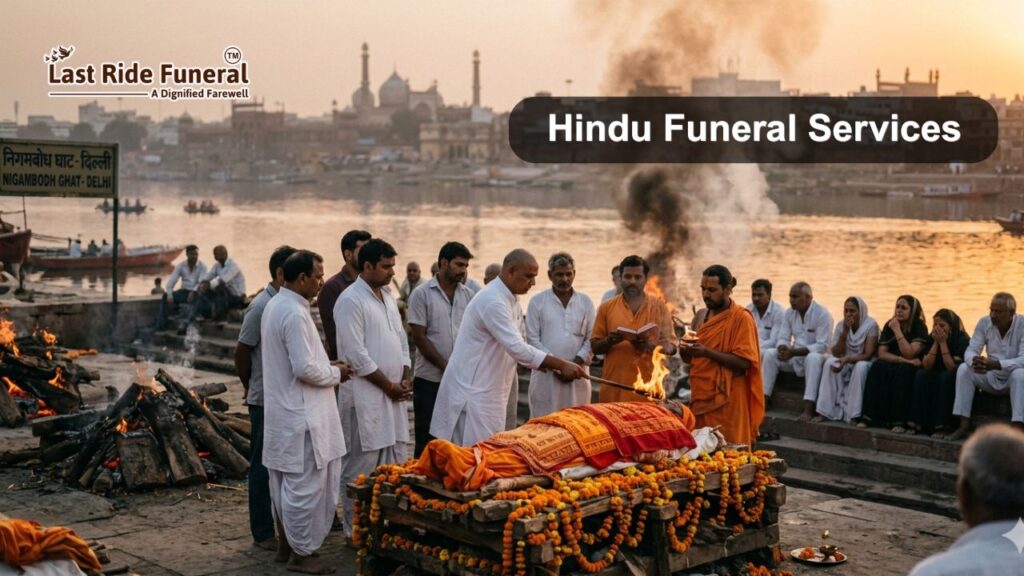
On a traditional open-air wooden pyre (such as at Nigambodh Ghat or Varanasi), the average fire temperature hovers around 650°C to 800°C. Consequently:
* Gold chains, rings, or nose studs do not vaporize or disappear.
* The metal becomes severely charred, blackened by carbon, twisted, and brittle, often fusing into surrounding wood embers or bone fragments.
* When the ashes are cooled with water the following morning during the Asthi Sanchayana ritual, any unremoved gold will be visible among the ashes. Historically, this has attracted unethical scavengers who pan riverbed sediment with magnets and strainers.
2. In Modern Electric or CNG Crematoria
Inside a closed municipal electric or gas retort chamber, temperatures routinely reach 1,000°C to 1,150°C. At this intense heat:
* Gold and silver jewelry melt completely, pooling into irregular, molten nuggets.
* When the chamber is swept and the bone fragments are transferred to the processor (cremulator), molten metal blobs become embedded within the granulated ash.
* In automated crematoria with magnetic separators, ferrous metals are filtered out, but non-ferrous metals like gold remain scattered in microscopic fragments throughout the collected remains (Asthi).
2. The Vedic Rule: Why ALL Jewelry Must Be Removed Before Cremation
In Sanatana Dharma, leaving commercial jewelry on a deceased body is strictly contrary to scriptural tenets. The Garuda Purana, Manusmriti, and Ashvalayana Grihya Sutras outline clear guidelines for preparing human remains for the sacred last sacrifice (Antyesti).
┌────────────────────────────────────────────────────────────────────────────────────────┐
│               THE 3 SCRIPTURAL REASONS ALL JEWELRY IS REMOVED BEFORE PYRE             │
└───────────────────────────────────────────┬────────────────────────────────────────────┘
                                            │
    ┌───────────────────────────────────────┼───────────────────────────────────────┐
    ▼                                       ▼                                       ▼
【 Total Spiritual Detachment 】     【 Natural Elemental Return 】        【 Protection from Profanity 】
 • Soul must sever all ties to       • Body must merge cleanly into        • Prevents sacred cremation ground
   earthly wealth & status.            Pancha Bhoota without metal locks.    from becoming site of theft.
 • Shroud must be unstitched cloth.  • Metal constricts energy pathways.   • Heirlooms passed as blessings
 • "Empty-handed we depart."         • Pure wood & samagri sacrifice.        to surviving children/grandchildren.
1. The Principle of Utmost Detachment (Vairagya)
Cremation is a sacred Vedic Yajna wherein the physical body is offered back to Agni Devata. Adorning a corpse with expensive gold jewelry binds the subtle consciousness (Sukshma Sharira) to earthly possessiveness and vanity. The unstitched, plain white or saffron cotton shroud (Kafan) signifies that every human being departs this mortal realm in total equality, stripped of material ego.
2. Gold in the Mouth (Mukhe Hiranya) vs. Heavy Jewelry
Many families confuse commercial jewelry with the ancient ritual of placing a microscopic particle of gold in the mouth.
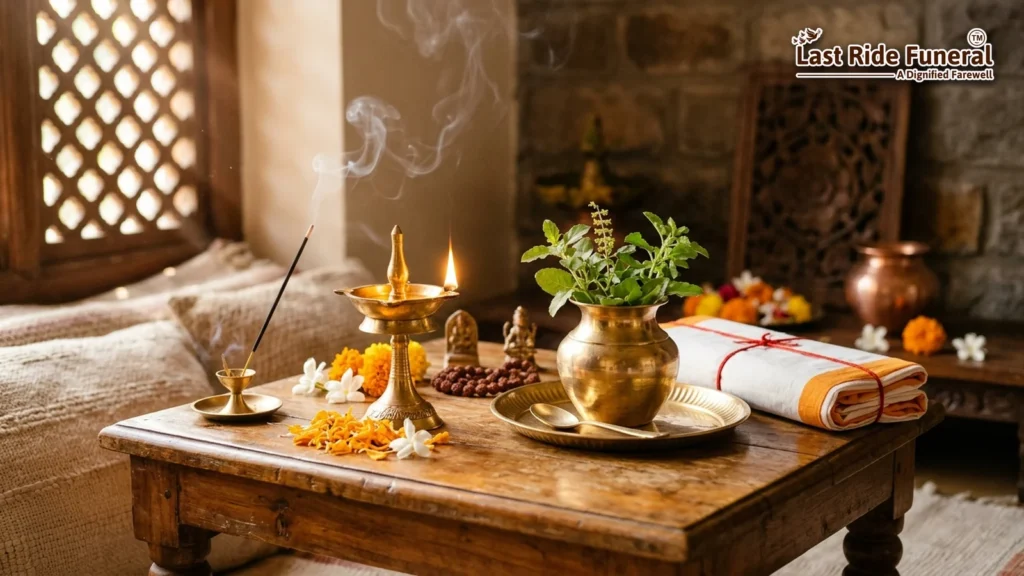
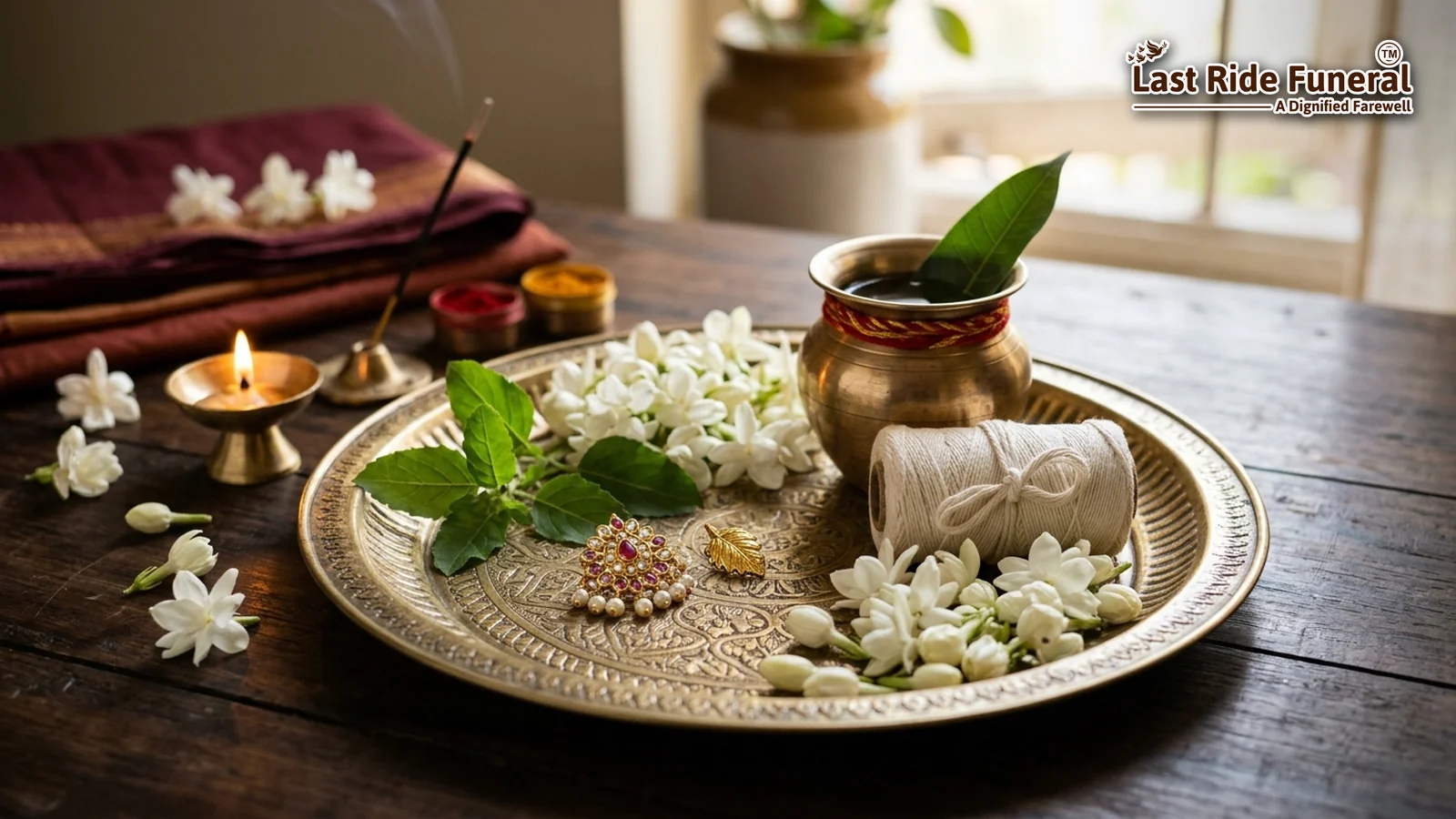
According to the Garuda Purana, before the funeral pyre is lit, a tiny speck of pure gold, a drop of holy Gangajal, and a fresh Tulsi leaf are placed inside the mouth of the deceased (read our complete guide on why gold and Tulsi are placed in the mouth).
* This is a symbolic spiritual sacrament to sanctify the vocal portal (Vak Indriya).
* It requires only a microscopic foil or gold dust flake—never heavy necklaces, bangles, or rings.
3. The Family Checklist: When and How to Safely Remove Jewelry
To avoid heartbreaking disputes, theft, or emotional distress, families should observe this practical mortuary protocol immediately following a demise:
+----------------------------------------------------------------------------------------------------+
|                         STEP-BY-STEP JEWELRY REMOVAL & INVENTORY CHECKLIST                         |
+--------------------+------------------------------------+------------------------------------------+
| Stage              | What to Inspect and Remove         | Who Should Supervise                     |
+--------------------+------------------------------------+------------------------------------------+
| 1. Hospital Bed /  | • Gold earrings, nose studs/pins   | Two designated family elders             |
|    Mortuary Handoff| • Wedding rings, kada, gold chains | (Avoid leaving this to hospital staff)   |
|                    | • Wristwatches, sacred amulets     |                                          |
+--------------------+------------------------------------+------------------------------------------+
| 2. Antim Snana     | • Silver anklets (Payal/Bichhiya)  | Elder women of the family (for females); |
|    (Last Bath)     | • Sacred threads with gold beads   | Elder men (for male deceased)            |
|                    | • Verify all finger rings removed  |                                          |
+--------------------+------------------------------------+------------------------------------------+
| 3. Final Bier Prep | • Final physical check before the  | Chief Mourner (Karta) and                |
|    (Arthi Bandhana)|   shroud is tied with white cord   | Senior Funeral Director                  |
+--------------------+------------------------------------+------------------------------------------+
Important Practical Tips:
- Dealing with Swollen Fingers: Due to post-mortem fluid shifts and early rigor mortis, rings often become tightly stuck. Do not use violent force. Use a drop of vegetable oil, liquid soap, or the gentle “thread-wrapping technique” to slide the ring off smoothly without damaging delicate skin.
- Nose Pins and Small Studs: Tight screw-back earrings and nose pins are the most frequently forgotten items. Appoint one family elder specifically to inspect the ears and nose before the final shroud is placed.
- What to Do with the Removed Jewelry: In traditional Indian households, jewelry worn by a departed mother or grandmother is never sold casually. It is thoroughly washed in Gangajal and milk, kept safely, and passed down as an auspicious heirloom (Ashirwad) to daughters, daughters-in-law, or grand-daughters during auspicious future ceremonies.
4. What If Jewelry Was Accidentally Left on the Body?
If the funeral pyre has already been lit or the casket has entered an electric crematory before anyone realized a gold ring or nose pin was left behind:
- Do Not Panic or Stop the Pyre: Disrupting a burning funeral pyre causes severe spiritual disrespect and immense emotional trauma.
- Inform the Crematorium Supervisor: If it occurred in an electric or CNG crematorium, inform the station manager immediately. In many modern facilities, magnetic and manual ash screening allows staff to recover melted metal nuggets when collecting the Asthi the next morning.
- Open Pyre Ash Collection: The chief mourner (Karta) should look carefully during the morning Asthi Sanchayana when gathering bone fragments. Any burnt metal remnant can be recovered and immersed with the ashes in the Ganges or kept privately.
More From Last Ride Funeral
5. Frequently Asked Questions (FAQs)
Does gold melt during a traditional Hindu open pyre cremation?
No. Pure gold melts at 1,064°C, whereas an open wooden pyre typically burns between 650°C and 800°C. Gold jewelry left on an open pyre will not vaporize or fully melt; instead, it becomes heavily charred, blackened by carbon, twisted, and fused with charcoal and bone ash.
Does gold melt in an electric or CNG crematorium?
Yes. Electric and CNG cremation furnaces operate at intense temperatures between 1,000°C and 1,150°C. At this level of heat, 14K to 22K gold jewelry melts completely into irregular molten nuggets that blend into the bone ash and cremator floor.
Why do Hindu scriptures mandate removing all jewelry before cremation?
According to the Garuda Purana, the soul must depart this earthly existence in complete detachment (Vairagya) from material wealth and ego. Adorning a corpse with expensive jewelry binds subtle energies to worldly possessions. Furthermore, plain unstitched cotton shrouds symbolize universal human equality in death.
What is the ritual of placing gold in the mouth before death (Mukhe Hiranya)?
The sacred ritual of Mukhe Hiranya involves placing a microscopic speck or foil of pure gold, along with holy Gangajal and a Tulsi leaf, into the mouth of the dying or deceased. This is an ancient symbolic Vedic sacrament to purify the vocal organ and ensure spiritual passage, distinct from wearing heavy commercial ornaments.
When is the best time for the family to remove gold jewelry?
Jewelry should be removed in two stages: primary items (necklaces, wristwatches, heavy rings) should be removed immediately upon release from the hospital bed or morgue, while intimate items (earrings, nose pins, silver toe rings) are gently removed during the final ritual bath (Antim Snana) before wrapping the shroud.
How do you remove a tight gold ring from a swollen deceased finger?
Never use violent force. Apply vegetable oil, liquid soap, or petroleum jelly to the finger, or use the gentle thread-wrapping technique around the knuckle to ease the ring off smoothly without tearing delicate post-mortem tissues.
What should families do with jewelry removed from a departed loved one?
Traditional Vedic custom advises washing the removed ornaments in clean water, raw milk, and Gangajal. The jewelry is preserved as a sacred heirloom (Ashirwad) to be gifted to children, daughters-in-law, or grandchildren during future auspicious family milestones.
How does Last Ride Funeral ensure ethical security during cremation arrangements?
Last Ride Funeral assigns dedicated, senior mortuary coordinators who guide families through a formal pre-shroud inventory check. Our coordinators ensure all ornaments and valuables are safely handed over to the designated family elder before arriving at the cremation ground. Call our 24/7 helpline at +91 92171 79989 for transparent, compassionate support.
Conclusion: Honoring the Soul with Reverence and Clarity
The final journey of a human being in Sanatana Dharma is designed to reflect the ultimate truth of existence: we enter this world with nothing, and we depart with nothing except our karma and spiritual merit.
Removing gold jewelry from a departed loved one is not merely a practical safeguard against loss or theft; it is an act of profound spiritual love. It releases the soul from earthly tethers, honors the simplicity of sacred rites, and preserves precious memories as blessings for generations to come.
For 24/7 compassionate funeral coordination, hearse transportation, Antim Sanskar Samagri kits, and verified crematorium slot bookings across Delhi NCR:
- 24/7 Helpline: +91 92171 79989
- Official Website: https://lastridefuneral.in/
- Service Coverage: Delhi, Gurgaon, Noida, Greater Noida, Ghaziabad, and Faridabad.