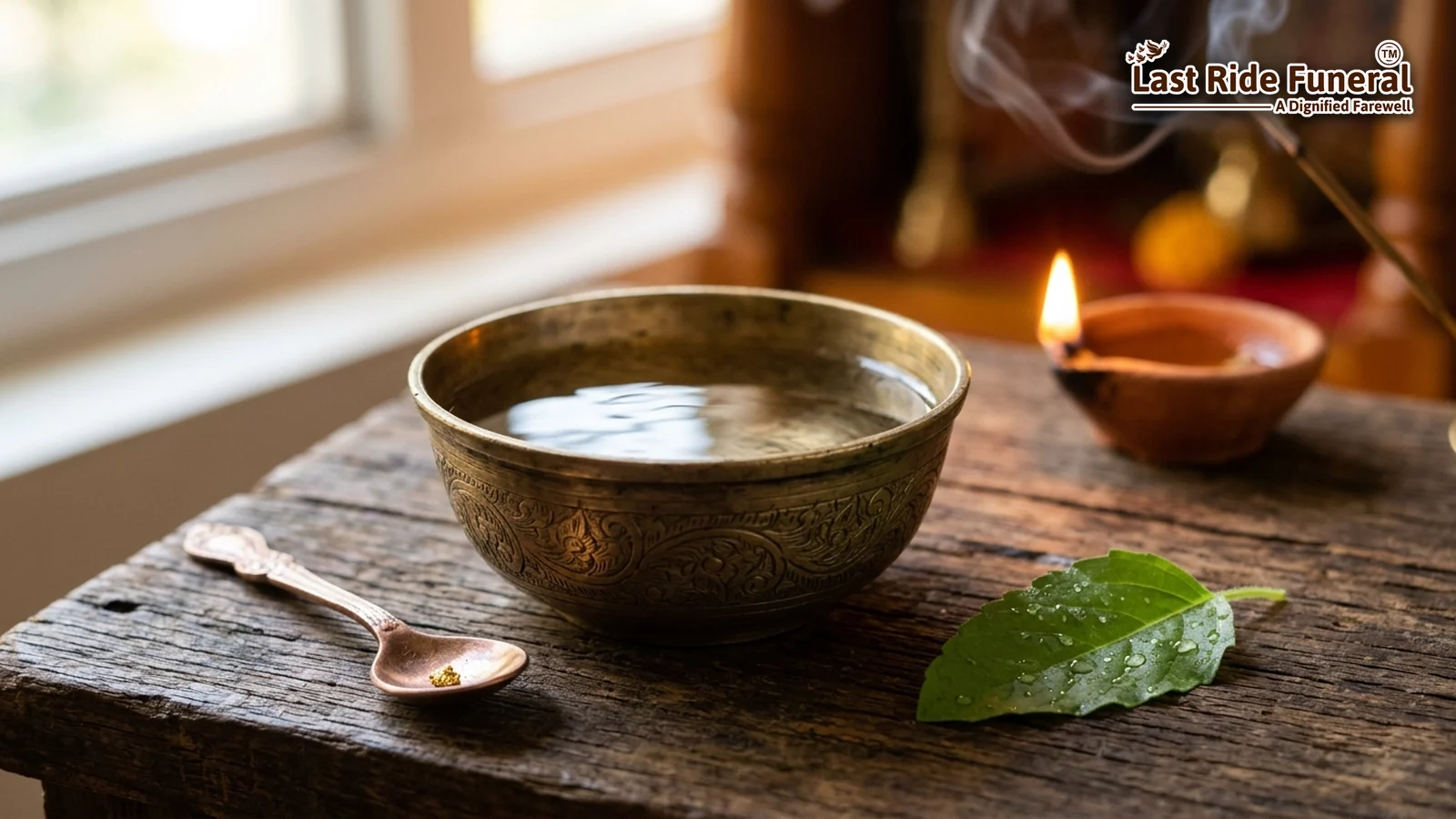
Why Gold, Tulsi, and Ganga Jal Are Placed in the Mouth at the Moment of Death: The Vedic Mukha-Shuddhi Mystery
Across thousands of years, whenever a Hindu elder reaches the fragile threshold between physical life and eternity, family members gather closely around the bedside. In that sacred, hushed quietude, an ancient tripartite ritual unfolds: a micro-flake of pure gold (Kanchana), a fresh green leaf of Holy Basil (Tulsi), and a few drops of sanctified water from the River Ganges (Ganga Jal) are placed gently upon the tongue of the dying.
To an outside observer, this tender bedside act may seem like an esoteric ritual. Yet in classical Vedic philosophy and the profound verses of the Garuda Purana, this rite—known technically as Mukha-Shuddhi (Oral Sanctification) and Karna-Kavacha—represents one of the most compassionate, metaphysical, and physiologically brilliant farewell practices conceived in human civilization.
Last Ride Funeral coordinates with families across Delhi NCR during these intimate transitions. Here, we unveil the spiritual, psychological, and physiological science behind why these three sacred substances are offered at the moment of the final breath.
1. The Tripartite Trinity: Symbolism at the Threshold
The final breath (Antima Shwasa) is not considered a biological failure in Vedic thought; it is the critical juncture when the conscious spirit (Jiva) decouples from the gross physical sheath (Annamaya Kosha).
Vedic sages understood that the oral cavity is the primary portal of speech, nourishment, and breath. To ensure the soul’s departure occurs through an unblemished medium, three cosmic elements are united:
                      ┌───────────────────────────────────────┐
                      │  The Vedic Mukha-Shuddhi Trinity      │
                      └──────────────────┬────────────────────┘
                                         │
         ┌───────────────────────────────┼───────────────────────────────┐
         ▼                               ▼                               ▼
     Pure Gold                        Tulsi Leaf                    Ganga Jal
  (Suvarna / Agni)               (Vrinda / Vaikuntha)           (Primal Purity)
  • Imperishable element         • Cellular bio-calm             • Cosmic solvent
  • Incorruptible medium         • Antimicrobial shield          • Quenches parched throat
  • Dissolves speech karma       • Wards off dark vibrations     • Washes mortal sins
2. Why Pure Gold (Suvarna)? The Incorruptible Element
In the Garuda Purana (Preta Kanda, Chapter 2), Lord Vishnu explicitly instructs Garuda regarding the moment of passing:
” मुखे सुवर्णं निक्षिप्य गङ्गातोयं च पावनम् । तुलसीदलमथाधाय मुच्यते सर्वकिल्बिषैः ॥”
(By placing gold in the mouth along with pure Ganga water and a Tulsi leaf, the departing jiva is freed from all accumulated impurities.)
The Spiritual Significance of Gold:
- The Seed of Lord Agni (Agnereva Hiranyam): In Vedic metaphysics, gold is revered as the crystallized essence of fire (Agni Tattva). Gold cannot rust, tarnish, oxidize, or absorb organic decomposition. By placing gold upon the tongue, the dying individual’s speech faculties—and whatever unintended verbal sins, falsehoods, or regrets were uttered during a lifetime—are symbolically transmuted and purified by Agni before judgment.
- Conductivity of Subtle Energy: Gold is among the most magnetically and energetically conductive metals on earth. In yogic science, gold assists in drawing the vital prana upward toward the higher chakras (Vishuddha and Sahasrara), encouraging the soul to exit through upper noble portals rather than descending apertures.
- Sealing the Senses: In royal Vedic traditions, microscopic gold flakes or pearls were placed over the nine gates of the body to prevent lower astral entities from latching onto the vacant energetic shell.
3. Why the Sacred Tulsi Leaf? The Floral Chariot to Vaikuntha
The Holy Basil plant (Ocimum sanctum) is far more than a garden herb in Hinduism; she is revered as Vrinda Devi, the eternal spiritual consort of Lord Vishnu.
The Metaphysical Armor:
- Divine Jurisdiction: The Skanda Purana notes that messengers of darkness or distressing astral dimensions (Yamadutas) cannot step within the perimeter of a home consecrated by the scent of fresh Tulsi. A single leaf upon the tongue serves as an auspicious spiritual passport, assuring the departing soul of safe transit into benevolent spiritual realms (Vaikuntha).
- Subtle Aromatherapy: The sharp, cooling, clove-like aromatic terpenes of fresh Tulsi penetrate the dying sensory receptors, calming agitation and replacing panic with deep spiritual surrender.
The Physiological Reality:
In modern palliative medicine, dying patients experience extreme dryness of the oral mucosa and respiratory secretions known colloquially as the “death rattle.” Placing a fresh Tulsi leaf stimulates salivary glandular reflex without triggering choking, while its rich natural eugenol acts as a mild localized antiseptic and mucosal soother.
4. Why Ganga Jal? The Primordial Cosmic Solvent
The third essential element is water from the sacred River Ganga, collected in sealed brass or copper vials (Ganga-Jali).
- Quenching the Agonal Thirst: In the final hours before death, severe dehydration causes the throat muscles to tighten and the tongue to stick to the palate. A single drop of Ganga water from a clean conch shell (Shankha) or silver spoon immediately relieves this severe dryness, allowing the person to rest peacefully.
- Dissolving Karmic Bonds: Scripturally, Ganga represents the celestial stream that flowed from the toes of Lord Vishnu and was gentled within the matted locks of Lord Shiva. Because her currents carry the spiritual merit of countless millions of prayers, her water functions as a cosmic spiritual solvent, dissolving the psychological heaviness of unresolved attachments (Moha).
- The Final Physical Sustenance: In Hindu tradition, Ganga Jal is the last material substance consumed by a human being. The journey began at birth with mother’s milk; it concludes at death with the celestial waters of Mother Ganga.
5. Comparative Table: Classical Scriptural Verse vs. Modern Scientific Correlate
| Component | Vedic / Scriptural Mandate | Physiological & Psychological Correlate |
|---|---|---|
| Gold (Suvarna) | Garuda Purana: Agni’s unblemished seed that purifies speech and seals sensory orifices. | Chemically inert; non-reactive with dry oral tissues; provides psychological reassurance of ancestral honor. |
| Tulsi Leaf | Skanda Purana: Vrinda’s shield that repels lower astral confusion and invites divine peace. | Natural eugenol and terpenes soothe airway passages; mild sensory stimulation alleviates agonal respiratory distress. |
| Ganga Jal | Padma Purana: The water that frees the soul from cycle of fear and cleanses mortal sin. | Rehydrates parched lips and throat (xerostomia); softens vocal cords; allows relaxed respiration without choking. |
6. How Families Should Administer This Rite Respectfully
When an elder is actively dying, the ritual should be performed with immense gentleness:
– Do Not Force Liquids: Never pour large volumes of water into the throat of an unconscious individual, as this can trigger aspiration into the lungs. Use an eyedropper, a clean silver spoon, or dip the tip of a Tulsi leaf into Ganga Jal to place single drops upon the lips and tongue.
– Small Flakes of Gold: Use a microscopic piece of clean, hallmark gold (such as the tip of a pure gold wire, earring post, or foil). If physical gold is unavailable, a clean gold ring dipped momentarily into the Ganga Jal before moistening the lips is fully accepted in Vedic jurisprudence (Apat-dharma).
– Chant Sacred Syllables: While offering these three sacred substances, whisper the Maha Mrityunjaya Mantra, Gayatri Mantra, or the holy name “Rama” or “Om Namo Narayanaya” into the elder’s right ear (Karna-Mantra).
7. The Bridge to Antim Sanskar
Once the final breath departs and Mukha-Shuddhi has fulfilled its ancient mandate, the physical body transforms from Jiva into Shava (sacred remains). The family prepares the body for its next journey toward funeral rites and cremation.
At Last Ride Funeral, we stand with families across Delhi NCR to uphold every delicate Vedic tradition with reverence, offering compassionate hearse transport, freezer box preservation, and licensed Vedic pandits across all regional cremation grounds:
- 24/7 Bereavement Helpline: +91 92171 79989
- Official Website: https://lastridefuneral.in/
More From Last Ride Funeral
Frequently Asked Questions (FAQs)
What is the Vedic purpose of placing gold in the mouth before death?
In Vedic scriptures and the Garuda Purana, gold is revered as the purest element born of Lord Agni (Agnereva Hiranyam). Placing gold in the mouth symbolically incinerates lifetime speech impurities, attracts spiritual light, and guides prana upward toward higher energy centers.
Can ordinary water be substituted if Ganga Jal is not available?
If genuine Ganga Jal is not immediately available, Vedic texts permit clean water consecrated with sacred mantras, water infused with Tulsi leaves, or water from other sacred rivers like the Yamuna, Godavari, or Narmada.
Is there a risk of choking when giving water to a dying person?
Yes. When swallowing reflexes weaken near death, pouring large amounts of liquid can cause respiratory distress. The tradition specifically mandates placing only a few drops on the tongue using a spoon or moistening the lips with a Tulsi leaf.
What kind of gold should be used for this ritual?
A tiny flake of pure 24-carat gold wire, clean unembellished jewelry, or an Ayurvedic gold foil (Swarna Bhasma base) is ideal. If gold is not on hand, touching a gold ornament to Ganga Jal and applying the sanctified water to the lips fulfills the rite.
Why is the Tulsi leaf considered essential during the final breath?
Tulsi is venerated as the sacred embodiment of Goddess Vrinda and Lord Vishnu. Scripture states that her presence creates a sanctified perimeter that calms the departing soul, dispels existential fear, and ensures smooth spiritual elevation.
What should family members chant while administering Mukha-Shuddhi?
Family members should softly chant the Maha Mrityunjaya Mantra, the Gayatri Mantra, or the name of the Divine (such as “Hare Krishna” or “Shri Rama”) into the right ear of the passing person to keep their mental focus elevated.
Does this ritual apply to hospital ICU settings?
Yes. Even in an intensive care unit, doctors and nursing staff typically permit close relatives a moment of bedside prayer. Moistening the lips with a drop of Ganga Jal and touching a clean Tulsi leaf to the forehead or mouth is widely respected across hospitals in India.
What is the next immediate step after the final breath departs?
After clinical passing is confirmed, the family should gently close the eyes and mouth, straighten the limbs, light a small pure ghee lamp near the head, and contact a dignified funeral service provider at 9217179989 for mortuary van dispatch and cremation coordination.



Comments